Engagement the true essence of solving problems Life is an algorithm, only engage with what you want more of We cannot solve our problems with the same thinking we used when we created them(Einstein) "You will continue to suffer if you have an emotional reaction to everything that is said to you." (Warren Buffett)
Algorithmic thinking is a systematic problem-solving approach that breaks down a complex challenge into a precise, ordered sequence of logical steps and rules. Rather than guessing an answer, it designs a replicable process that both humans and computers can follow to yield a predictable, efficient result.
Defined steps: Every action follows a logical sequence from start to finish.
Replicable processes: It creates a formula that can solve similar problems repeatedly, much like a cooking recipe or math formula.
Automation: Clear rules allow humans or computers to execute tasks efficiently without guessing. Emotionless Nature: It removes frustration, panic, and bias by treating decisions as objective rules and conditions.
Zero Ambiguity: Every step has a distinct start, middle, and end, leaving no room for confusion.
Core Components of Algorithmic Thinking
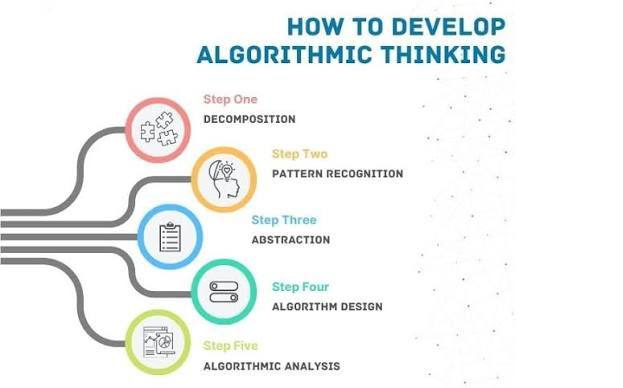
Decomposition: Splitting a large, intimidating problem into smaller, manageable sub-problems.
Pattern Recognition: Identifying similarities, trends, and regularities within the data or process.
Abstraction: Filtering out irrelevant details to focus strictly on the core logic and essential rules required for the solution.
Logical Sequencing: Arranging instructions in the precise, correct chronological order with clear starting and endpoints
Sequencing: Putting steps in the exact correct order because order dictates success (like putting on socks before shoes).
Conditional Logic: Using "if/then" decisions to change the path when specific conditions are met.
Looping: Repeating a set of actions to save time and effort until a task finishes
Understand the Problem: Clearly define the expected inputs, boundaries, constraints, and desired outputs.
Design the Algorithm: Sketch a visual flowchart or write plain-English pseudocode to map out conditional decisions (if/else) and repetitions (loops).
Implement the Solution: Translate the logical steps into a structured medium or a high-level programming language like Python.
Test and Refine: Validate correctness across standard cases, edge scenarios, and invalid inputs, optimizing for efficiency and scalability.
Why It Feels 'Emotionless'—and Why That is Useful
When faced with sudden or complex crises, human psychology naturally triggers stress, anxiety, or emotional bias. Algorithmic thinking serves as an intentional circuit breaker for those emotional loops:
Neutralizes Panic: By shifting focus from the gravity of the whole problem to the execution of the first micro-step, it bypasses the "fight-or-flight" mental freeze.
Minimizes Bias: It relies on objective data and logical inputs rather than wishful thinking, mood, or intuition.
Differentiates the Process from the Person: In this framework, a failure is not a personal shortcoming—it is simply a "bug" in the step-by-step logic that needs to be isolated and patched
You don't need a computer to use this strategy; it applies directly to everyday stress and decisions:
Scenario Emotional/Reactive Approach A Financial Deficit | Panic, avoiding the bank account, feeling guilty about spending. An Overwhelming Project | Procrastinating because the final objective feels impossibly large. A Relationship Conflict | Reacting defensively, rehashing past arguments, shouting.
Scenario Algorithmic Approach A Financial Deficit |Decompose:Group expenses into Fixed vs. Variable.Step 1:Cut the highest variable expense.Step 2:Audit next week. An Overwhelming Project |Abstract:Ignore the deadline for a moment.Decompose:Isolate the very first piece of data required. A Relationship Conflict |Isolate variables:Separate the current action from past history. Establish clear communication parameters.
🛠️ Key Building Blocks of an Algorithm
When designing the final solution, algorithmic thinkers structure their instructions using three foundational constructs:
Sequencing: Ordering tasks in a strict, logical progression. Changing the sequence can break the entire process.
Conditionals (Decision Making): Using "If-Then" logic. This allows the process to branch down different paths depending on constraints or changing data.
Loops (Iteration): Repeating a set of instructions efficiently until a specific condition or goal is met, eliminating redundant work




Comments (0)
No comments yet. Be the first to share your thoughts.