"Trust is good, verification is better!" ( Adi Dassler, the founder of Adidas) “Think outside the box, only then will new ideas come to you.” (Adi Dassler) Impossible is Nothing (Adidas) "Innovate — don't imitate." "Only by trying can the wrong become right."
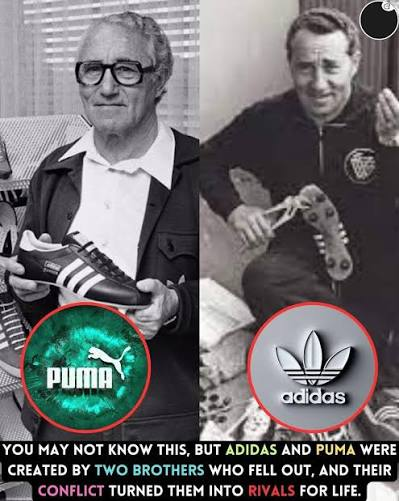
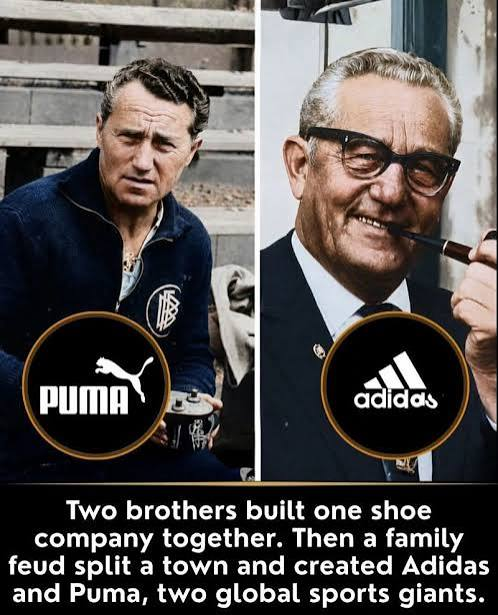
Adidas and Puma were born in 1948 from a bitter personal feud between founding brothers Adolf "Adi" and Rudolf "Rudi" Dassler, permanently dividing their shared company and hometown into a legendary global sportswear rivalry
An enduring separation 🔨 The Foundation: Gebrüder Dassler Schuhfabrik In the 1920s, brothers Adolf ("Adi") and Rudolf ("Rudi") Dassler started making sports shoes in their mother’s laundry room in Herzogenaurach, Germany.
Adi was the quiet craftsman and innovator, obsessed with designing the perfect shoe.
Rudi was the extroverted salesman, masterfully marketing and distributing their creations.
The Roots of the Company
1924: The brothers started the Gebrüder Dassler Schuhfabrik (Dassler Brothers Shoe Factory) in Herzogenaurach, Germany.
1936: Their athletic shoes gained worldwide fame when Jesse Owens wore them to win four gold medals at the Berlin Olympics.
World War II: Rising political tensions, operational disagreements, and a rumored misinterpretation during an Allied bomb shelter attack fractured their relationship beyond repair.
The 1948 Split
The Division: Unable to work together anymore, the brothers split the company's assets, inventory, and workforce in 1948. Adi kept most of the product developers and shoe designers, while Rudi took the marketing and sales workforce.
Rudolf's Brand: Rudolf moved to the south side of the Aurach river and initially named his company Ruda before changing it to Puma in 1948.
Adolf's Brand: Adolf took the north side of the river and combined his nickname and last name to officially launch Adidas in 1949, registering the famous three stripes.
A Town Divided
The "Town of Bent Necks": Residents of Herzogenaurach looked down at people's shoes to see which brand they wore before deciding to talk to them.
Segregated Life: Townsfolk frequented different local bakeries, pubs, and businesses depending on which brother they worked for.
The Legacy: The fierce corporate rivalry pushed both brands to dominate global sports marketing and celebrity endorsements before a symbolic reconciliation match in 2009. The split
Built to Endure: Adidas and Puma, the split traces how two German sportswear giants evolved from shared roots into distinct brands shaped by business strategy, manufacturing choices, and brand identity. Adidas grew into a global leader by standardizing performance footwear and apparel, expanding distribution through partnerships and licensing, and repeatedly investing in materials and design improvements that supported durability under heavy use. Puma, while also scaling production and product lines, differentiated through faster design cycles, a strong emphasis on style and lifestyle adoption alongside athletics, and targeted collaborations that helped it maintain relevance across changing consumer tastes. Both companies benefited from advances in synthetic materials, improved rubber compounds for outsoles, and more efficient production methods that increased consistency and lifespan, while their long-term brand endurance was reinforced by sustained marketing presence in sport and culture. The “split” ultimately reflects not only corporate separation but also divergent approaches to innovation, market positioning, and how each brand translated engineering durability into recognizable, lasting consumer trust.
A Longstanding Corporate Legacy
The competitive friction forced both companies to innovate aggressively to survive. While Adidas dominated performance sports through technical engineering, Puma expanded heavily into fashion, lifestyle, and culture-driven partnerships.
The brothers died in the 1970s without ever truly reconciling, and they were buried at opposite ends of the same town cemetery. It wasn't until September 2009 that employees from both companies finally held a symbolic friendly soccer match to bury the decades-long hatchet.
Comments (0)
No comments yet. Be the first to share your thoughts.
Comments (0)
No comments yet. Be the first to share your thoughts.