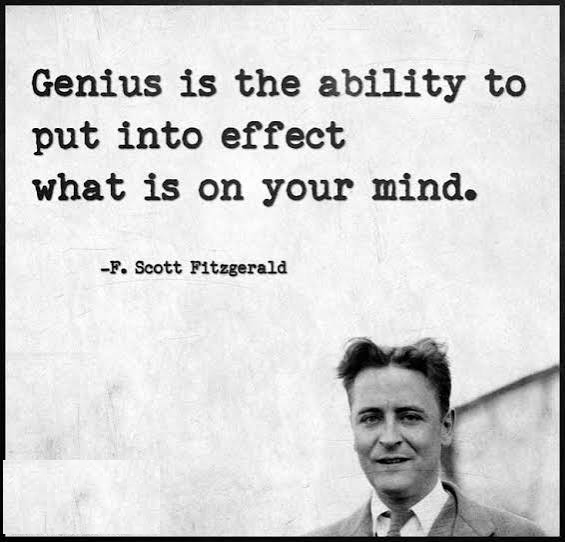
"Do not be emotionally attached to your excuses, Your stories becomes your principles and your principles becomes your identity" "outcome always hide the process, growth is never glamourous, it is fueled by pain and continous invisible efforts" we will end up living in a house built with yesterday decision. Jim Rohn. " Intelligence endures when it self-corrects" "Whatever you worship controls you, if fear is your idol, so shall fear rules your affairs" (Odeyemi Daniel) Self-Discovery, there is a genius embedded in everyone. Odeyemi Daniel Set your genius into motion
To force your brain to think like a genius, you must replace passive memorization with active cognitive struggle, deep focus, and the deliberate application of mental models.
"Built to Endure" and "Force Your Brain to Think Like a Genius" highlight a paradigm shift in cognitive performance: genius is not an innate gift of high IQ, but an active, structured system of mental friction and resilience. High-level thinkers systematically leverage cognitive strain, feedback loops, and mental frameworks to transform surface-level effort into profound intelligence.
Thinking like a machine means using data, clear logic, and pattern recognition to make smart choices, while moving humanely means leading with empathy, ethical reasoning, and emotional intelligence. Balancing these two approaches allows you to solve hard problems efficiently without losing your personal touch. Self Discovery, there is a genius embedded in everyone.
Embrace Cognitive Discomfort
Struggle longer: Genius is rarely about instant answers; as Albert Einstein noted, it is about staying with a hard problem significantly longer than most people.
Avoid early relief: Resisting the urge to immediately check an answer allows your brain to recruit more neurons and tag the problem as high-priority.
Use active recall: Close your books or notes after reading a section and explain the concept out loud in simple terms to instantly expose gaps in your understanding.
Apply Powerful Mental Frameworks
The Idea Collider: Do not just protect single concepts; combine ideas from completely different fields (like Steve Jobs combining calligraphy with computing) to spark innovation.
Map out complexity: Use visual tools like a 3x3 grid (the Lotus Method) to break an overwhelming, intimidating project down into small, visible, and actionable steps.
Keep favorite problems: Maintain a running list of a dozen major questions or problems in your head, constantly testing new information against them.
To force your brain out of passive auto-pilot and activate its highest problem-solving capacity, you can implement the following core evidence-backed methodologies:
1. Shift from Passive Recognition to Active Wrestling
Most people default to "passive receiving" when reading or studying. This tricks the brain into confusing recognition with mastery.
The 60-Second Reconstructive Rule: Close your material, look away, and explain the concept out loud in your own words as if teaching a complete novice. The physical act of translating thoughts into spoken language forces sequential logic and instantly exposes blind spots. Stumbling through these gaps creates a "failure index" that alerts your brain's salience network to prioritize the problem.
2. Embrace the Cognitive Friction of Pen and Paper
Geniuses from Leonardo da Vinci to Richard Feynman historically offloaded their internal landscape onto paper. Typing on a screen lacks tactile resistance, whereas writing with a physical pen engages your brain deeply. It forces you to pause, structure chaos, and map out complex relationships, which builds robust neural pathways over time.
3. Deconstruct Overwhelming Tasks (The Lotus Method)
When faced with a massive, ambiguous project, your brain perceives the uncertainty as a threat and triggers an avoidance response.
Map the Architecture:Break large concepts or goals down into micro-components before you start. By converting an unmapped mental wall into a highly specific script or protocol, you minimize decision fatigue and preserve your prefrontal cortex's concentration for deep, strategic thinking.
4. Build Aggressive Feedback Loops
Intelligence endures when it self-corrects. To build high-level mental clarity, you must stress-test your ideas against reality rather than relying on internal assumptions. Write down your hypotheses, try to actively disprove your own arguments, and look for flaws or contradictions.



Comments (0)
No comments yet. Be the first to share your thoughts.