They said the things you are building is a toy , prove them wrong on the newspaper front page.
"only great marketing is needed to make a company successful"
"Hans Wilsdorf did not just engineer a reliable watch; he engineered an unbreakable business model that guarantees Rolex remains permanently synonymous with enduring quality. "
Rolex watch is discovery of perpetual initiation.
Rolexwas built to endure through the visionary leadership of its founder, Hans Wilsdorf, who transformed the wristwatch from a fragile piece of women's jewelry into the ultimate symbol of durability, precision, and luxury. Today, the company generates an estimated $13 billion in annual revenue and commands roughly a third of the entire luxury watch market.
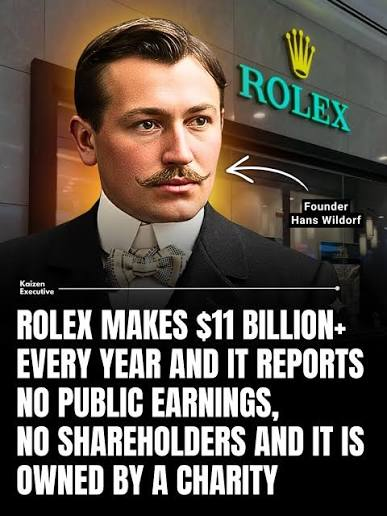
Hans Wilsdorf (22 March 1881 – 6 July 1960) was a German watchmaker, best known as the founder of Rolex and Tudor. Wilsdorf's philosophy for the companies was "only great marketing is needed to make a company successful"
watches are crafted by great minds with finest materials and assembled with scrupulous attention to details.
the Oyster Perpetual 28mm (Ref. 276200), which features an official Manufacturer's Suggested Retail Price (MSRP) of approximately $5,800.
Hans Wilsdorf built Rolex on a simple but demanding idea: produce watches that could reliably endure everyday life and extreme conditions. In 1905, he began working in London with the goal of creating timepieces that were both accurate and practical, and by 1908 his company had earned a reputation for precision, including winning official chronometer trials. A key step came in 1910 when Wilsdorf moved the business to Switzerland, where he could work more directly with established watchmaking expertise while continuing to push for higher standards in accuracy and durability. Rolex’s early engineering focus addressed the realities of wear—protecting mechanisms from dust and moisture, improving performance under varying temperatures, and ensuring consistent timekeeping. In 1914, the company registered the name “Rolex,” and it soon became associated with reliability rather than luxury alone. The brand’s growth was reinforced by rigorous testing and by innovations that strengthened the watch’s ability to keep time over long periods, culminating in widely recognized milestones such as the Oyster case design, which helped make the watch more resistant to water and dust. Wilsdorf’s leadership also emphasized global reach and credibility, using official certifications and chronometer results to demonstrate performance. By combining Swiss manufacturing, systematic testing, and a relentless commitment to robustness, Hans Wilsdorf and Rolex created a legacy of watches designed not merely to be worn, but to last.
Orphaned early: Born in Bavaria in 1881, Hans Wilsdorf was an orphan by age 12 and learned self-reliance at a young age.
Starting the company: He moved to Switzerland, became fascinated by watchmaking, and launched the business in London with Alfred Davis in 1905.
The Rolex name: Registered in 1908, the short, easily spoken name was designed to look elegant on any watch dial.
Major Innovations
The Oyster (1926): The world’s first truly waterproof and dustproof wristwatch, famously proven when Mercedes Gleitze wore it swimming across the English Channel.
The Perpetual Rotor (1931): A self-winding mechanism that removed the need to manually wind the watch every day.
Perpetual excellence: Wilsdorf drove technical rigor and in-house manufacturing standards that prioritize long-term durability over fast trends.
The Hans Wilsdorf Foundation
Protecting independence: Following the death of his wife in 1944, Wilsdorf transferred 100% of his Rolex shares to a private trust, the Hans Wilsdorf Foundation.
No public shareholders: The structure ensures the company never faces quarterly pressures from public stock markets or corporate buyouts.
Philanthropic mission: A portion of Rolex profits continues to fund charitable, educational, and cultural endeavors.
The Three Pillars of Rolex Innovation
Wilsdorf's pursuit of excellence was anchored by three core technical breakthroughs that defined the modern wristwatch:
Chronometric Precision: In 1910, a Rolex became the first wristwatch to receive the Swiss Certificate of Chronometric Precision, proving that small wrist-worn timepieces could be as accurate as large marine chronometers.
The Oyster Case (1926): Wilsdorf developed the world's first waterproof and dustproof watch case, named the "Oyster". To prove its utility, he equipped swimmer Mercedes Gleitze with an Oyster when she swam across the English Channel; the watch emerged perfectly intact.
The Perpetual Movement (1931): To resolve the issue of dust and water entering the watch via an unscrewed winding crown, Rolex invented the first self-winding mechanism with a free-roaming perpetual rotor. This captured the energy of the wearer's wrist movements to keep the watch wound indefinitely.
The Masterstroke: The Hans Wilsdorf Foundation
Following the tragic passing of his wife in 1944, and having no children of his own, Wilsdorf faced the dilemma of what would happen to his wildly successful enterprise. Rather than selling the company or letting it be dismantled by corporate raiders, he committed a masterstroke of corporate governance.
In 1945, he established the Hans Wilsdorf Foundation and transferred 100% of his ownership stakes in Rolex to it. When Wilsdorf passed away in 1960, the foundation took complete control.
Because of this structure, Rolex operates with an unmatched long-term perspective:
No Growth Pressure: Rolex does not answer to Wall Street or short-term investors.
Retained Value: The company intentionally maintains supply below market demand to protect the long-term value and exclusivity of its timepieces.
Philanthropy: All net profits that are not reinvested into upgrading factories and horological technology are directed by the foundation to support charities, social causes, and the arts in Switzerland.
Hans Wilsdorf did not just engineer a reliable watch; he engineered an unbreakable business model that guarantees Rolex remains permanently synonymous with enduring quality.


Comments (0)
No comments yet. Be the first to share your thoughts.