Business Ideas & Implementation
Built to Endure: Levi Strauss Company, The journey of a jean in a gold mine.
August 29, 2026 · 36 views ·by Odeyemi Oluwafemi
The gold mines have long been emptied, but the riveted pants built to survive them continue to endure in wardrobes worldwide.
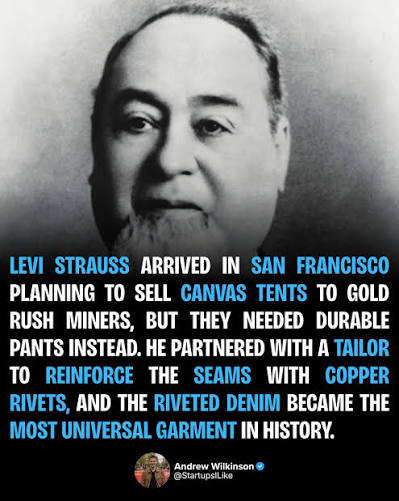
The Birth of Riveted Denim
Miners constantly complained that their standard trousers ripped apart under the weight of heavy tools and the friction of jagged rock walls.
- The Tailor’s Solution: In 1872, Jacob Davis, a tailor from Nevada, came up with a fix: reinforcing high-stress points like pocket corners with small copper rivets.
- The Historic Patent: Lacking funds to secure a patent alone, Davis partnered with his fabric supplier, Levi Strauss. On May 20, 1873, they received U.S. Patent No. 139,121. This date marks the official birth of the blue jean, originally marketed as "waist overalls."
The Journey of a Jean in a Gold Mine
For a miner, a pair of Levi's was a critical piece of safety equipment. Made of tough cotton denim from the Manufacturing Company, these pants were treated as disposable work gear. When miners finished their grueling shifts, worn out, torn, or discarded pants were frequently left behind. They were thrown into the rubble of abandoned shafts or used to wrap leaky pipes.
Over more than a century, the unique, arid environment of abandoned western mines perfectly preserved these discarded garments
Levi Strauss & Co.’s blue jeans were built to endure because they were designed for work in harsh conditions, and the classic story of a jean’s journey begins with the realities of mining. In a gold mine, clothing is exposed to abrasive dust, constant friction, sharp tools, and long shifts that demand fabric strength and reliable construction. Levi Strauss’s early workwear—made from sturdy denim and reinforced with practical tailoring—was created to withstand repeated wear rather than to look fashionable for a short season. The denim itself was selected for durability, and the garments were constructed with attention to stress points such as seams, hems, and closures, where failure would be most likely under strain. As miners and other laborers wore these jeans, the jeans proved their value through performance: they held up to repeated movement, resisted tearing better than lighter fabrics, and maintained usability despite the rough handling typical of industrial work. Over time, that proven durability helped transform the jean from workwear into an enduring staple, carrying forward the same core purpose—fabric and construction engineered to last—while spreading far beyond the mine.
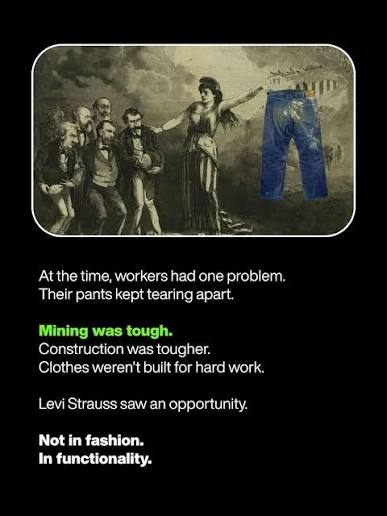
The Underground Environment
Extreme Friction: Miners scraped against jagged tunnel walls, sharp rocks, and abrasive ore fragments.
Heavy Tool Loading: Tassels, heavy iron picks, and gold nuggets strained pocket seams to their absolute breaking point.
Candlelight & Heat: Pitch-black shafts illuminated only by wax candles meant hot drippings frequently scorched the heavy fabric.
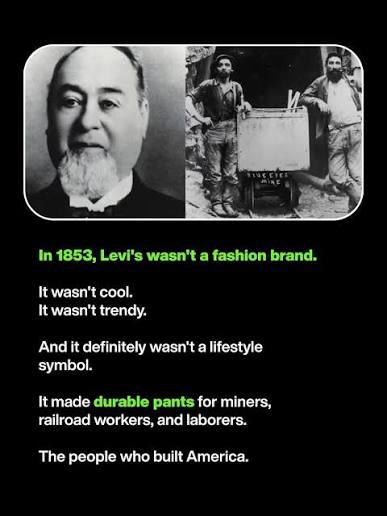
Stress-Point Armor: Tailor Jacob Davis realized hammering small copper rivets at pocket corners stopped the tearing cold.
The Patent Partnership: Lacking the $68 needed for the patent fee, Davis wrote to dry-goods merchant Levi Strauss, cementing a historic business alliance.
Indestructible Proof: The famous 1886 "Two Horse" leather patch graphically demonstrated that two horses couldn't rip a pair of riveted Levi's apart.
Legacy from the Depths
Preserved Artifacts: Original 1880s and 1890s Levi's pulled from abandoned Western mines still bear physical traces of authentic candle wax and mud, acting as priceless historical relics.
From Function to Fashion: What began as disposable work gear for grit-covered prospectors evolved into a universal symbol of endurance, style, and youth culture
Comments (0)
No comments yet. Be the first to share your thoughts.