A small group of ambitious industrialists transformed the United States from a fractured, post-Civil War nation into a modern global economic superpower through fierce competition, ruthless business tactics, and massive technological innovation.
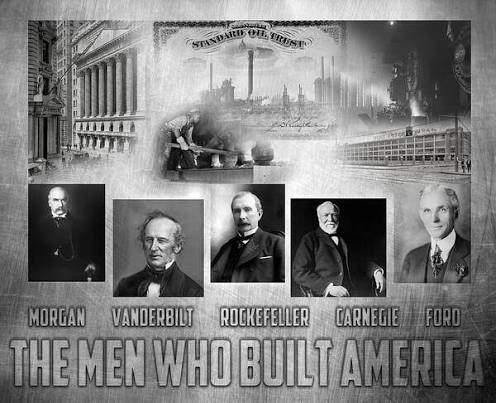
Industrial pioneers like Cornelius Vanderbilt, John D. Rockefeller, Andrew Carnegie, J.P. Morgan, and Henry Ford who shaped modern U.S. industries including rail, oil, steel, and finance.
The building of America is a complex historical process spanning indigenous societies, European colonization, the 1776 Declaration of Independence, and rapid industrialization. It transformed a land of diverse native nations into thirteen British colonies, a sovereign constitutional republic, and a modern global economic power. The men behind the indusrial revolution
Key Industrial Pioneers
Cornelius Vanderbilt: Dominated the railroad and shipping transport networks. He began in steamboat shipping before pivoting entirely to consolidate the railroad industry, creating a unified transport network that connected the American continent .
John D. Rockefeller: Controlled the petroleum and oil refining monopoly via Standard Oil. The founder of Standard Oil, he pioneered horizontal integration to control 90% of America's oil refining capacity, bringing cheap kerosene—and later gasoline—to the masses
Andrew Carnegie: Revolutionized mass steel production.
An immigrant who went from rags to riches, he mass-produced structural steel using the Bessemer process, quite literally building America's skyscrapers and suspension bridges upward.
J.P. Morgan: Consolidated massive corporate and banking finance empires. The architect of modern American capitalism who consolidated fractured markets, financed Thomas Edison's electrical grid, and famously acted as a lender of last resort to save the U.S. economy from total collapse.
Henry Ford: Pioneered the automobile assembly line and mass production. He revolutionized manufacturing by pioneering the moving assembly line, bringing affordable, mass-produced cars to the middle class and entirely reshaping the American landscape
Core Characteristic
Industrial Age Growth: Rapid transition from a fractured nation to a connected industrial powerhouse.
Ruthless Competition: Aggressive tactics used to crush rival businesses and form monopolies.
Government Regulation: The eventual antitrust pushback and rise of federal oversight.
Early History and Colonization
Indigenous Peoples: Millions of Native Americans lived across the continent with complex societies, long before European arrival.
European Exploration: Beginning in the late 15th century, nations like Spain, France, and England explored and claimed land.
First Settlements: Jamestown, Virginia was founded in 1607 as the first permanent English colony.
Regional Growth: New England, the middle colonies, and the southern colonies developed distinct economies based on farming, trade, and forced slave labor.
Revolution and Independence
Growing Tensions: Taxes imposed after the French and Indian War strained ties with Great Britain.
Declaration: The Continental Congress adopted the Declaration of Independence on July 4, 1776.
New Government: The U.S. Constitution was written in 1787, creating a federal republic with George Washington as the first president.
Expansion and Industrialization
Continental Growth: The nation expanded westward through purchases and treaties during the 19th century.
Industrial Giants: Figures like Carnegie, Rockefeller, and Vanderbilt built massive steel, oil, and rail industries.
Economic Rise: America grew into a dominant financial and industrial center by the 20th century.
📜 Political & Social Architecture
Beyond steel and stone, the nation was built on ideas, struggles, and institutional frameworks. [1]
Indigenous Roots: Long before European arrival, millions of Indigenous peoples built complex societies deeply connected to the land.
Colonial Beginnings: The founding of Jamestown in 1607 and Plymouth in 1620 established the early roots of British America.
The Human Cost: The wealth that funded the nation's early growth was heavily driven by the forced labor of millions of enslaved Africans, creating a lasting civil rights struggle.

Comments (0)
No comments yet. Be the first to share your thoughts.