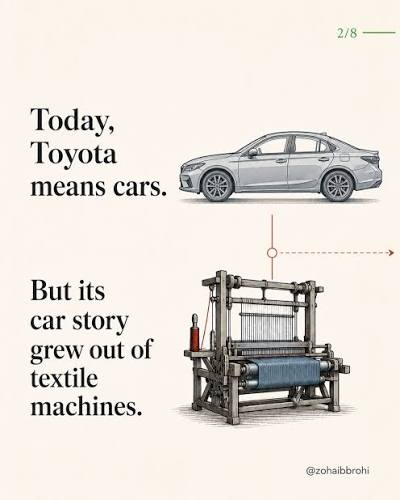
The remarkable history of Toyota begins not with an automobile engine, but with the rhythmic clacking of a textile loom built by the son of a poor carpenter. The phrase "Built to Endure: Toyota, The untold story of a Carpenter's Son that built a Car Empire" highlights the profound generational legacy of Sakichi Toyoda—the carpenter's son who revolutionized manufacturing—and his own son, Kiichiro Toyoda, who transformed that legacy into a global automotive powerhouse.
"Productivity is never an accident. It is always the result of a commitment to excellence, intelligent planning, and focused effort." — Paul J. Meyer. “The slower but consistent tortoise causes less waste and is more desirable than the speedy hare that races ahead and then stops occasionally to doze. The Toyota Production System can be realized only when all the workers become tortoises.” — Taiichi Ohno “Where there is no standard there can be no Kaizen [continuous improvement].” — Taiichi Ohno The making of Toyota, from Carpentry to automobile The story unfolds across three distinct eras of grit, engineering brilliance, and transformation:
1. The Carpenter’s Son and the Autonomous Loom
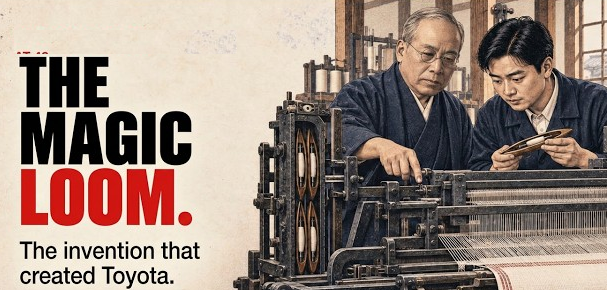
Sakichi Toyoda was born in 1867 in rural Shizuoka, Japan, to a humble farmer who also worked as a local carpenter. Learning the basics of woodworking in his father’s workshop, Sakichi became obsessed with solving a daily hardship: watching his mother and grandmother endure agonizing, slow hours weaving fabric on manual hand looms.
Defying his father's wishes, he used his carpentry skills to rethink machinery. In 1924, he perfected the Type G automatic loom. This revolutionary machine had a unique safety feature: if a single thread snapped, the entire loom immediately shut down to prevent defective cloth. This invention birthed the core Toyota manufacturing philosophy of Jidoka (automation with a human touch), which dictates that production must stop the instant an error occurs to guarantee quality.
2. A £100,000 Legacy and the Leap to Automobiles
Sakichi became known as the "King of Japanese Inventors," but his ultimate vision extended beyond textiles. In 1929, he sold the patent rights of his automatic loom to a British manufacturer, Platt Brothers, for roughly £100,000. Before passing away in 1930, Sakichi handed this small fortune over to his son, Kiichiro Toyoda, with a singular, radical mandate: use the capital to build a Japanese car company.
Kiichiro took his father’s obsession and started a small automotive department inside the loom factory in 1933. Lacking any prior automotive experience, Kiichiro and his team bought an American Chevrolet engine, disassembled it piece by piece, and meticulously reverse-engineered it to build their first prototype car, the Model AA, in 1936.
3. Surviving Crisis to Build an Empire
In 1937, the automobile division split off to form the Toyota Motor Corporation. The family changed the spelling from Toyoda to Toyota because writing "Toyota" in Japanese takes exactly eight brush strokes—a number associated with good luck and prosperity.
The young company almost didn't survive. Following the devastation of World War II, Toyota faced extreme financial ruin and devastating labor strikes in 1950. True to the family's code of honor, Kiichiro resigned to take full responsibility for the layoffs.
Though Kiichiro passed away shortly after, the foundation they built endured. Under later leaders like Eiji Toyoda and Taiichi Ohno, the principles of Jidoka and Kaizen (continuous improvement) evolved into the world-famous Toyota Production System (TPS). By eliminating waste and only manufacturing what was needed (Just-in-Time), Toyota out-engineered its massive American and European rivals to eventually become the largest, most reliable automaker on Earth. The transformation The Roots: Sakichi Toyoda and the Loom
The Carpenter's Son: Sakichi Toyoda grew up as the son of a poor carpenter in a Japanese farming village. Watching his mother and village women struggle with exhausting, hand-driven looms, he became obsessed with inventing a better way.
The Breakthrough: In 1924, he patented the Type G automatic loom. It featured Jidoka (automation with a human touch)—if a single thread broke, the machine automatically shut down to prevent mass defects.
The Seed Capital: In 1929, Sakichi Toyoda sold the international patent rights for his automatic loom to Britain's Platt Brothers for roughly £100,000. He handed this fortune to his son to fund a bold, unproven venture: building cars. The transformation of toyota Surviving Crisis and Building a Philosophy
Near Collapse: After World War II, Toyota faced severe bomb damage, massive debt, worker strikes, and a near-bankruptcy crisis in 1950. Kiichiro Toyoda eventually stepped down.
The Turnaround & TPS: Orders for military trucks during the Korean War and the creation of the Toyota Production System (TPS)—pioneered by figures like Taiichi Ohno using Just-in-Time and Kanban principles inspired by American supermarkets—turned the company around.
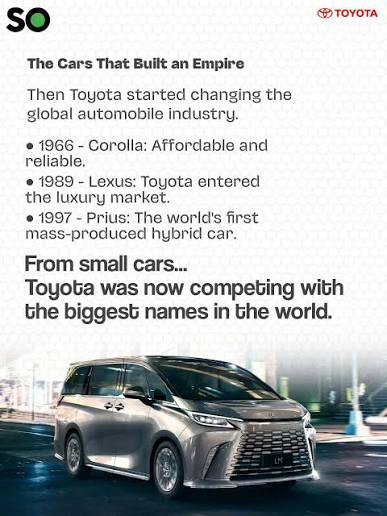
Global Dominance: By launching iconic, durable vehicles like the Land Cruiser and the Toyota Corolla (history's best-selling car), Toyota transformed from a risky side-project into the world's largest automotive manufacturer.
Comments (0)
No comments yet. Be the first to share your thoughts.
Comments (0)
No comments yet. Be the first to share your thoughts.