Business
Business: Differential Decisions and Analysis
July 21, 2026 · 7 views
Differential analysis is a managerial accounting method used to choose between alternatives by comparing only the revenues and costs that will change (incremental impact). It isolates relevant data while ignoring sunk costs and unavoidable expenses to determine which option maximizes profit or minimizes losses
It isolates relevant (differential) revenues and expenses while ignoring sunk costs and unavoidable overhead, allowing businesses to maximize profit when deciding between options.
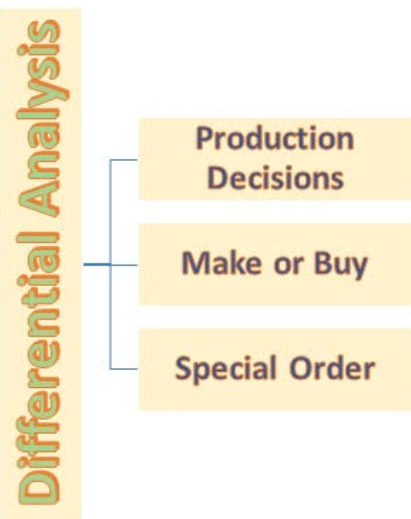
Differential decisions (or differential analysis) involve comparing the future costs and revenues of different alternatives.
Components of the Differential Analysis:
1. Differential Revenue: The difference in projected revenue between two alternatives.
2. Differential Cost: The difference in costs between alternatives.
3. Opportunity Cost: The potential benefit given up by choosing one alternative over another.
4. Avoidable Costs: Expenses that can be eliminated entirely if a specific alternative is chosen.
5. Sunk Costs: Historical costs that have already been incurred and cannot be recovered. These must be ignored in your analysis
Step-by-Step Approach to Differential Decision.
Define Alternatives: Clearly identify the options being evaluated (e.g., Status Quo vs. New Strategy).
Identify Relevant Factors: List the costs and revenues associated with each option, filtering out sunk or non-differential costs.
Compute Differentials: Subtract the revenue and costs of the baseline option from the alternative.
Evaluate Quantitative Results: The option with the highest net differential profit (or lowest differential cost) is theoretically the best.
Consider Qualitative Factors: Assess non-financial risks like employee morale, supplier reliability, or brand impact
Applications
Differential analysis is widely used to solve specific operational dilemmas:
Make or Buy: Evaluating whether it is cheaper to manufacture a component in-house or purchase it from an external supplier.
Keep or Drop a Product Line: Determining if discontinuing an unprofitable product will actually reduce total company profit because fixed costs are reallocated to other lines.
Sell or Process Further: Analyzing whether a product should be sold as-is or processed further into a higher-value good, comparing the additional revenue against the extra processing costs.
Special Orders: Deciding whether to accept a one-time order at a reduced price, as long as the revenue covers the incremental costs of producing the extra units.
Comments (0)
No comments yet. Be the first to share your thoughts.