Education
EDUCATION FOR EVERY CHILD: ARE WE REALLY INCLUDING STUDENTS WITH SPECIAL NEEDS?
August 25, 2026 · 16 views ·by Emma-Golden
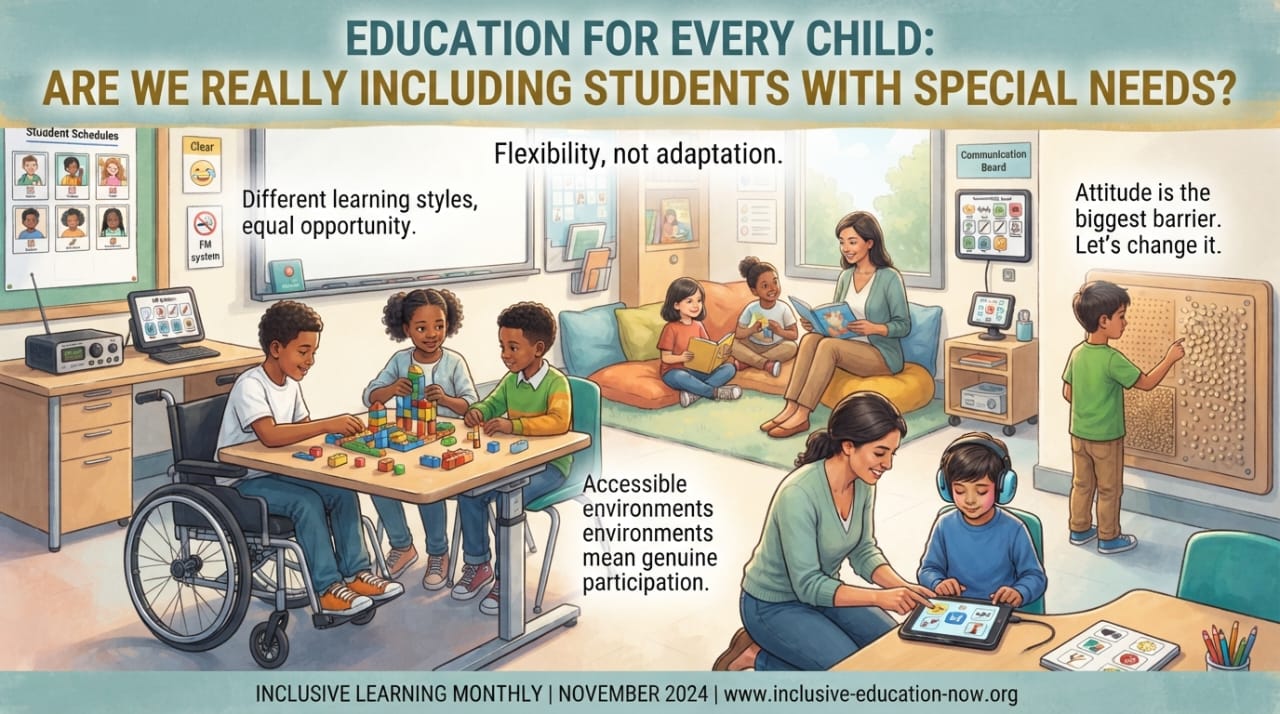
EDUCATION FOR EVERY CHILD: ARE WE REALLY INCLUDING STUDENTS WITH SPECIAL NEEDS?
Imagine placing twenty students in the same classroom and giving every one of them the exact same lesson, the exact same materials, the exact same amount of time and the exact same method of assessment.
Would that automatically mean they received an equal education?
Not necessarily.
Children learn differently.
Some understand concepts quickly through reading.
Others learn better through demonstrations, repetition, visual materials, movement or one-on-one guidance.
Some students may live with physical, sensory, intellectual or developmental disabilities that require additional support.
This is where inclusive education becomes important.
Inclusive education is based on the idea that students with special educational needs should not simply be placed in classrooms and expected to adapt to a system that was never designed with their needs in mind.
True inclusion requires the system itself to become more flexible.
That could mean accessible classrooms, learning materials designed for different abilities, assistive technologies, trained teachers, individualized support and an environment where students are treated with dignity rather than defined by their disabilities.
And there is another issue we cannot ignore: Attitude.
Sometimes the biggest barrier is not the disability itself. It is the assumption that a child cannot achieve much because of it.
A student who communicates differently may still be exceptionally creative.
A child who struggles academically may possess remarkable artistic, technical or problem-solving abilities.
A student who needs more time to learn may simply need a different approach, not lower expectations.
Unfortunately, some children with special needs also face isolation, bullying and misunderstanding from their peers.
This is why inclusion should not be treated as a special favour given to a few students. It should be understood as part of building an education system that recognizes that children are not identical.
Equality does not always mean giving everyone the same thing. Sometimes, it means giving people what they need to have a fair opportunity to succeed.
An inclusive school does more than educate children with special needs. It teaches every student something important about humanity: that difference is not a reason to exclude someone.
The goal should not simply be to get every child into a classroom.
The goal should be to make sure every child has a genuine opportunity to learn, participate, develop and belong.
Because education is truly inclusive only when no child has to wonder whether there is a place for them.
Imagine placing twenty students in the same classroom and giving every one of them the exact same lesson, the exact same materials, the exact same amount of time and the exact same method of assessment.
Would that automatically mean they received an equal education?
Not necessarily.
Children learn differently.
Some understand concepts quickly through reading.
Others learn better through demonstrations, repetition, visual materials, movement or one-on-one guidance.
Some students may live with physical, sensory, intellectual or developmental disabilities that require additional support.
This is where inclusive education becomes important.
Inclusive education is based on the idea that students with special educational needs should not simply be placed in classrooms and expected to adapt to a system that was never designed with their needs in mind.
True inclusion requires the system itself to become more flexible.
That could mean accessible classrooms, learning materials designed for different abilities, assistive technologies, trained teachers, individualized support and an environment where students are treated with dignity rather than defined by their disabilities.
And there is another issue we cannot ignore: Attitude.
Sometimes the biggest barrier is not the disability itself. It is the assumption that a child cannot achieve much because of it.
A student who communicates differently may still be exceptionally creative.
A child who struggles academically may possess remarkable artistic, technical or problem-solving abilities.
A student who needs more time to learn may simply need a different approach, not lower expectations.
Unfortunately, some children with special needs also face isolation, bullying and misunderstanding from their peers.
This is why inclusion should not be treated as a special favour given to a few students. It should be understood as part of building an education system that recognizes that children are not identical.
Equality does not always mean giving everyone the same thing. Sometimes, it means giving people what they need to have a fair opportunity to succeed.
An inclusive school does more than educate children with special needs. It teaches every student something important about humanity: that difference is not a reason to exclude someone.
The goal should not simply be to get every child into a classroom.
The goal should be to make sure every child has a genuine opportunity to learn, participate, develop and belong.
Because education is truly inclusive only when no child has to wonder whether there is a place for them.
Comments (0)
No comments yet. Be the first to share your thoughts.