The Classroom Wasn't Always Like This: Fascinating Facts About the History of Education
Before there were smart boards, notebooks, and school uniforms, education looked completely different.
Imagine walking into a classroom with no desks, no backpacks, no printed textbooks, and certainly no internet. Instead of opening an exercise book, you're handed a broken piece of pottery to write on. Instead of sitting in a brightly lit classroom, you're learning beneath a tree, inside a temple, or in a church. Strange? Maybe. But that's exactly how education looked for millions of students throughout history.
Education has existed for thousands of years, yet the classroom we know today is a surprisingly modern invention. The journey from ancient learning spaces to today's digital classrooms is filled with remarkable stories that many people have never heard.
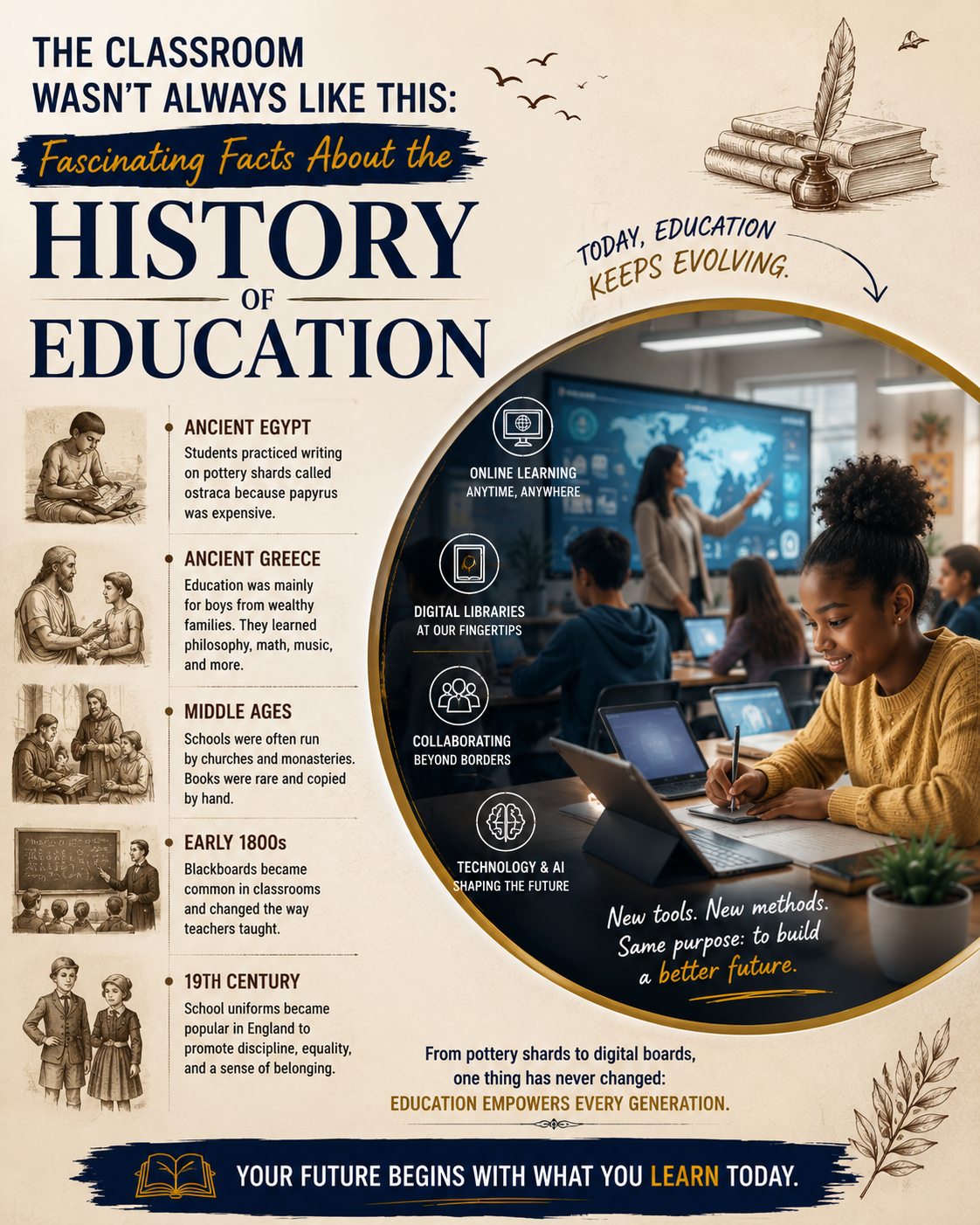
In ancient Egypt, paper made from papyrus was valuable and expensive, so young learners often practiced writing on broken pieces of pottery called ostraca or on flat pieces of limestone. These reusable surfaces allowed students to practice letters, numbers, and symbols without wasting costly materials. It was the ancient version of a practice notebook.
Meanwhile, in ancient Greece, education was considered essential, but not for everyone. Formal schooling was mainly reserved for boys from wealthy families. They studied reading, writing, mathematics, music, philosophy, and physical training. Girls, on the other hand, were usually educated at home, where they learned skills that society expected them to use later in life.
During the Middle Ages, schools were often connected to churches and monasteries because these institutions were among the few places where books and educated teachers could be found. Books were copied entirely by hand, making them incredibly rare and expensive. In some classrooms, an entire group of students would gather around a single book while their teacher read aloud. EDUCATION EVOLVES. Here's another fascinating fact: the familiar classroom blackboard didn't become common until the early nineteenth century. Before then, students usually carried small personal slates that could be written on with chalk, erased, and used again. The introduction of large blackboards made it much easier for teachers to instruct an entire class at once and changed the way lessons were delivered forever.
School uniforms also have an interesting story. Although different forms existed earlier, uniforms became more widespread in England as schools aimed to promote discipline, equality, and a sense of belonging. The idea was simple: when everyone dressed the same, students would focus more on learning than on social differences.
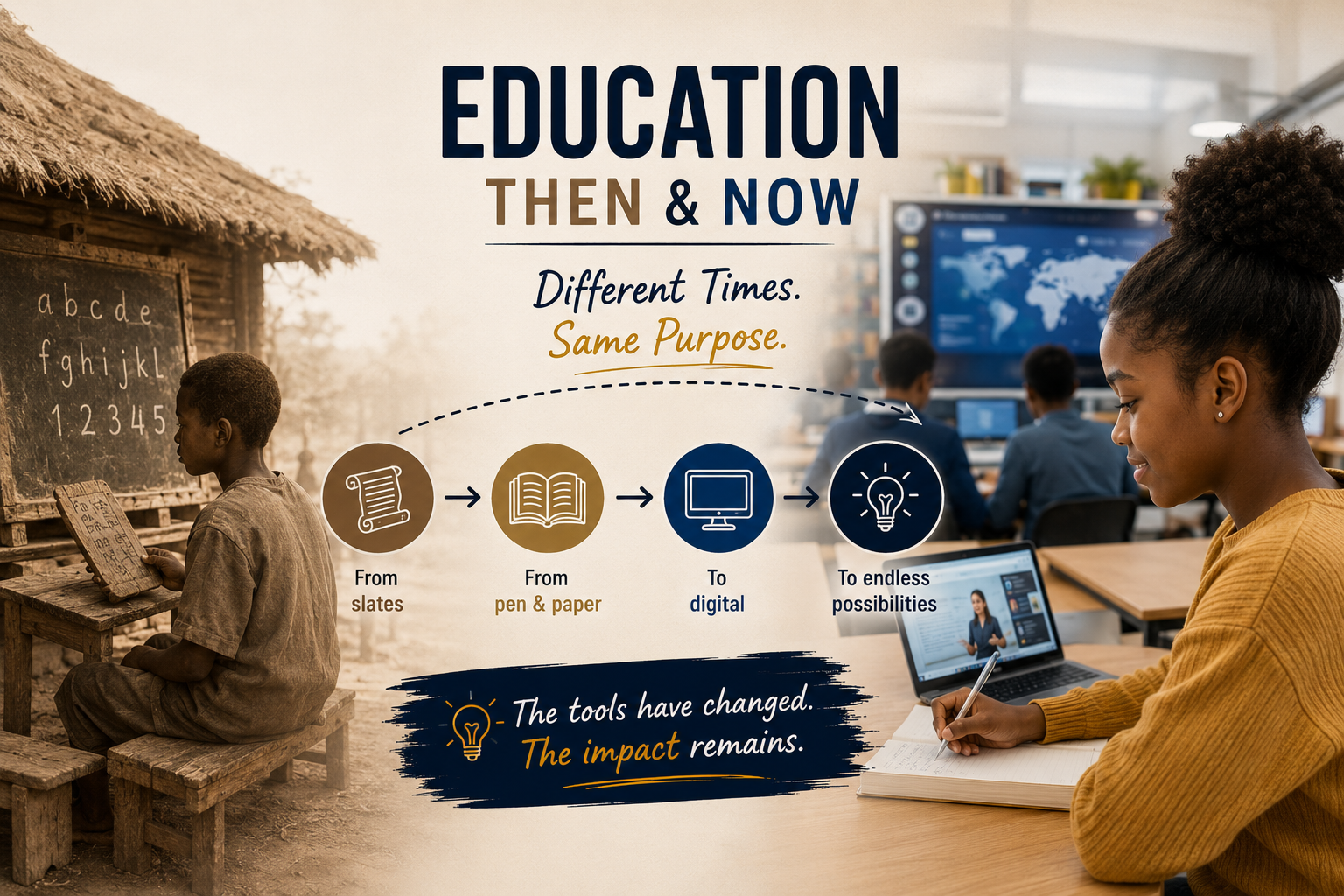
Today, classrooms are evolving faster than ever. Interactive whiteboards have replaced chalk in many schools. Libraries fit inside smartphones. Students can attend lessons online from different parts of the world and even use artificial intelligence to support their studies.
Yet despite all these changes, one thing has never changed: education has always been humanity's greatest tool for growth. Every generation has found new ways to pass knowledge to the next, proving that learning is not defined by buildings or technology, it is defined by curiosity, determination, and the desire to build a better future.
The next time you sit in a classroom or open a textbook, remember that you're taking part in a tradition that has traveled through thousands of years of history. The methods may have changed, but the purpose remains the same: to prepare minds for tomorrow.
History reminds us that education never stands still, and neither should we.
Comments (0)
No comments yet. Be the first to share your thoughts.
Comments (0)
No comments yet. Be the first to share your thoughts.