From a single point of focused intent—a singularity—to a vast commercial or technological domain, grand enterprises often spring from one core insight or recursive breakthrough. Just as a technological singularity imagines a point where intelligence explodes exponentially, business empires scale when a single foundational idea repeats, automates, and compounds without limit.
The Power of a Single Spark
The Singular Focus: A single, non-obvious truth or unorthodox premise drives the entire mechanism.
The Exponential Pivot: The moment the concept transitions from a linear task to a self-sustaining, compounding system.
The Network Effect: Growth shifts from internal push to external, automated pull.
From the moment the first singularity was conceived—a single, self-reinforcing idea that could scale faster than any individual effort—its proponents treated it less as a concept than as an operating system for society. They defined a clear mechanism (how the idea produced value), established repeatable methods (how it was implemented in new contexts), and built institutions to preserve continuity (how it was governed, funded, and improved).
Early wins proved the model: each deployment generated measurable outcomes, which then fed back into the next iteration, reducing cost, increasing reliability, and expanding adoption. As the idea matured, it attracted talent, capital, and partners, forming a network effect that centralized expertise and standardization while still enabling local execution. Over time, the network evolved into an empire—not merely through conquest, but through control of critical infrastructure: supply chains, platforms, standards, and information flows. The empire’s durability came from converting the original singular idea into layered systems—education pipelines, legal frameworks, and economic incentives—that ensured the idea could survive leadership changes and withstand competition.
In this way, one single idea became an empire by turning insight into a scalable engine, then embedding that engine into the structures that determine how people coordinate, trade, and govern.
The Software and IP Layer: Owning the underlying infrastructure or brand IP allows a business to profit from every transaction globally without manufacturing physical goods.
Backward Integration: Controlling the entire chain from raw materials to final distribution removes external dependencies and secures market dominance.
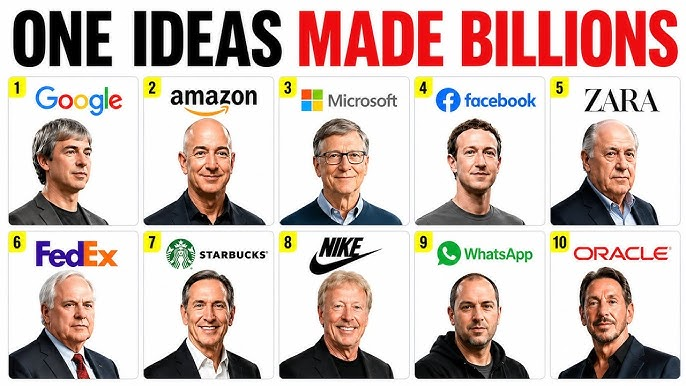
Microsoft / Bill Gates : Own the operating system software layer instead of building hardware. his idea created a global software monopoly powering personal computers worldwide.
Dangote Group / Aliko Dangote : Shift from importing commodities to manufacturing and owning the supply chain. his idea creates Africa's largest industrial and cement conglomerate.
Walt Disney : Create core characters and stories that branch into media, parks, and merchandise. this resulted to a multi-billion-dollar entertainment and media ecosystem.
Jamie Salter: He built a $36 billion empire without inventing a single brand.
Jamie Salter's entire philosophy is built on one idea: great brands don't die, they just need the right people behind them. He finds the ones with a heartbeat, dusts them off, and licenses every category to the best operator in the world for that specific thing.
His portfolio now includes Reebok, Champion, Elvis Presley, Muhammad Ali, Marilyn Monroe, Shaq, David Beckham, and Kevin Hart, operating across 150 countries.
He started with a paper route at ten years old, convinced his brothers to deliver the papers, and kept all the tips for himself. That same instinct, find the leverage others miss, is what built everything that came after.
Comments (0)
No comments yet. Be the first to share your thoughts.
Comments (0)
No comments yet. Be the first to share your thoughts.