-----There will always be a gray area in different shades of grey...... ----In Fuzzy logic, there is a degree of uncertainty between what is true and what is false..
In fuzzy logic, grey isn't just a colour, but there are different shades of grey. Fuzzy logic completely rejects the strict "Can or Cannot" binary by allowing for everything in between a true statement and a false statement.
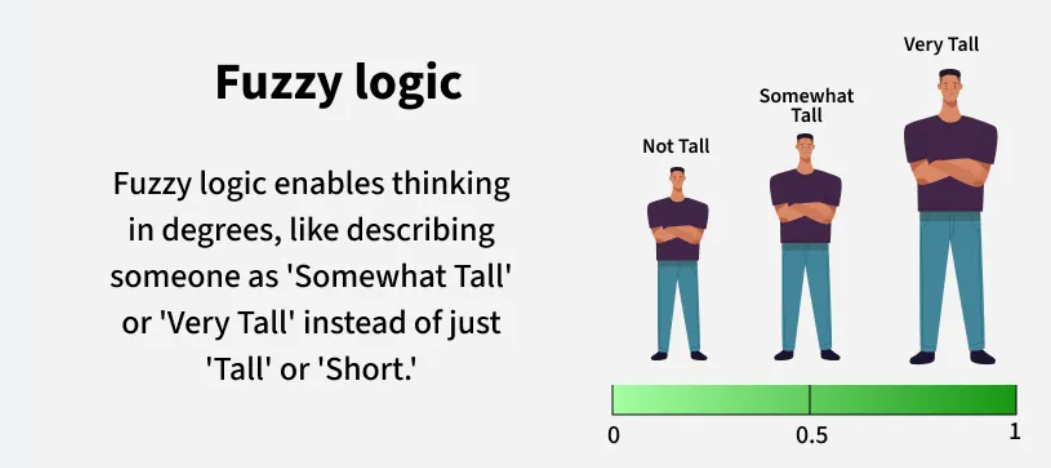
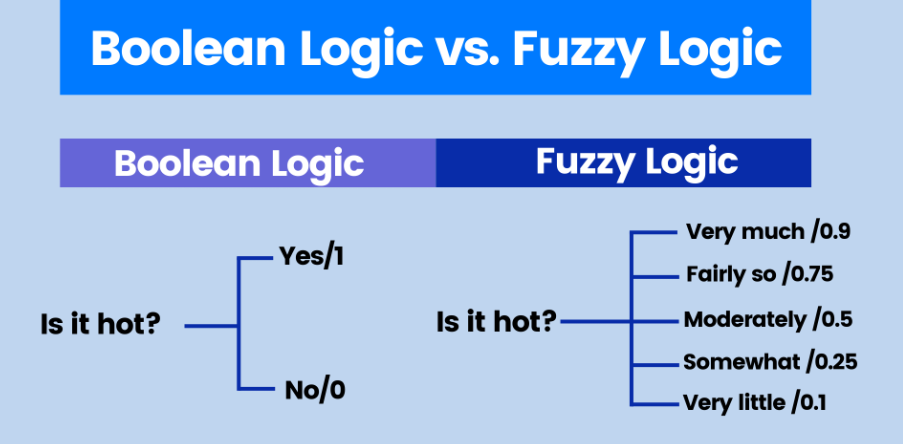
Fuzzy Logic bridges the gap between binary logic (yes/no) and human reasoning (maybe/sort of). Instead of strict 1s and 0s, it processes "degrees of truth" ranging from 0 to 1. It can handle ambiguity and vague variables, but it cannot solve problems requiring absolute binary precision.
In Fuzzy logic, there is a degree of uncertainty between what is true and what is false.
If all the truth points to the same direction, nothing in itself is true. binary logic versus fuzzy logic Fuzzy logic is a mathematical framework for dealing with uncertainty and imprecision, contrasting with classical binary logic where statements are either true or false. In fuzzy logic, truth values range between 0 and 1, allowing for degrees of truth that reflect the complexity of real-world situations. This approach is particularly useful in fields such as control systems, artificial intelligence, and decision-making processes, where binary classifications often fall short. By employing fuzzy sets, which can represent vague concepts, fuzzy logic enables more nuanced reasoning and better modeling of human thought processes, thus enhancing the ability to handle ambiguous information effectively.
In fuzzy theory, truth values are mathematically called membership values.
Complete Truth (1.0): A statement is absolutely, undeniably true. (e.g., A person who is 2.5 meters tall is 1.0 true for the fuzzy set "tall".)
Partial Truth (0.1 to 0.9): Statements possess a "degree of truth". (e.g., A person who is 1.7 meters tall might be considered "tall" with a truth value of 0.3, and "average height" with a truth value of 0.8.)
Complete Falsehood (0.0): The statement does not apply at all.
Fuzzy Logic vs. Probability
People often confuse fuzzy logic with probability, but they measure different things:
Probability is the mathematical model of ignorance or chance. It measures the likelihood that a specific, crisp event will happen (e.g., There is a 70% chance it will rain tomorrow).
Fuzzy truth is a mathematical model of vagueness. It measures the degree to which a condition currently exists (e.g., The rain outside is "heavy" with a truth value of 0.7).
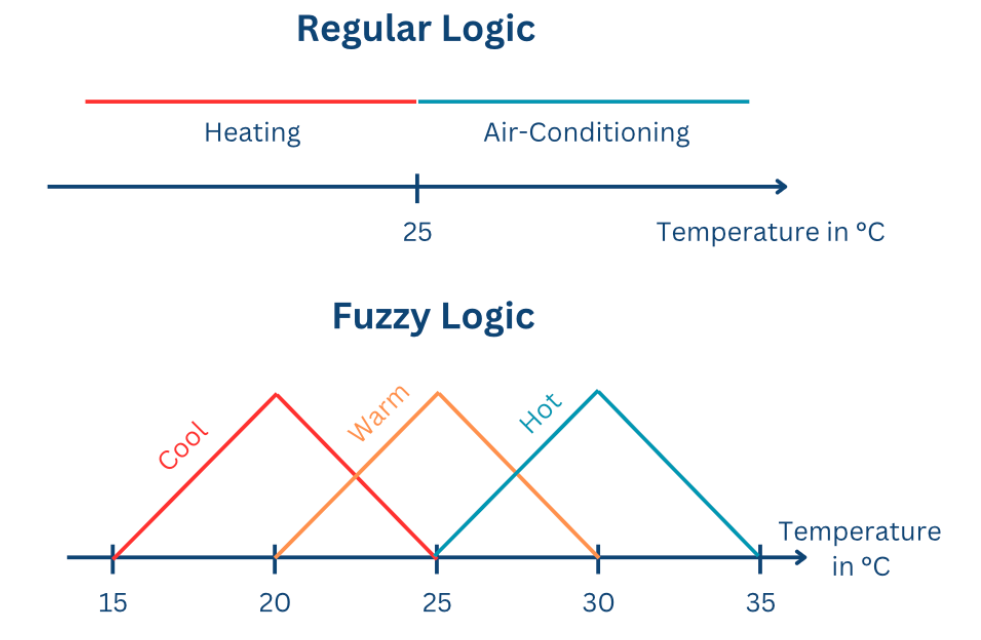
Traditional logic systems make decisions using strict numerical cutoffs (e.g., if a room is 25°C, it is either "hot" or not "hot"). Fuzzy logic introduces how hot is the coffee ? Common Applications
Fuzzy logic is widely used in systems where variables are continuous and exact mathematical modeling is complex or unnecessary.
Consumer Appliances: Rice cookers, washing machines, and air conditioners that adjust cycles or temperatures based on continuous sensor inputs.
Automotive: Anti-lock braking systems (ABS), transmission controls, and autonomous driving assistance for nuanced vehicle traction and speed management.
Industrial Control: Managing chemical distillation processes, water treatment (pH levels), and robotic movements. Search engine: uses algorithms outside of the classical yes or no; the ability to independently think of possible combinations.
Finance & AI: Assessing credit risk, evaluating personal performance, and natural language processing.
Comments (0)
No comments yet. Be the first to share your thoughts.
Comments (0)
No comments yet. Be the first to share your thoughts.