How It's Made
How it's Made: Coconut oil
August 17, 2026 · 24 views ·by Odeyemi Daniel
Coconut oil is made by extracting oil from the white inner flesh of mature coconuts. Factories and homes use different ways to do this, split into two main types: virgin coconut oil (from fresh milk) and refined oil (from dried copra).
Virgin Coconut Oil (Wet-Milling Method)
Grate: Fresh coconut meat is shredded or grated.
Extract Milk: Water is added to the grated meat and squeezed to make raw coconut milk.
Separate: The milk sits so the oil and water split apart.
Methods to Split:
- Boiling: Heating the milk until the water evaporates and the oil separates from the solids.
- Fermentation: Letting the milk rest for 24 to 48 hours so the oil rises to the top.
- Centrifuge: Using a fast machine to spin and separate the oil from the milk emulsion instantly.
Refined Coconut Oil (Dry Method)
Make Copra: Coconut meat is dried out using the sun, hot air, or kilns.
Press: The dried meat (called copra) goes into a heated machine press to squeeze out the crude oil.
Refine: The raw oil is filtered, bleached, and deodorized with steam to remove germs and the strong coconut smell.
▶ Watch the video, do it yourself
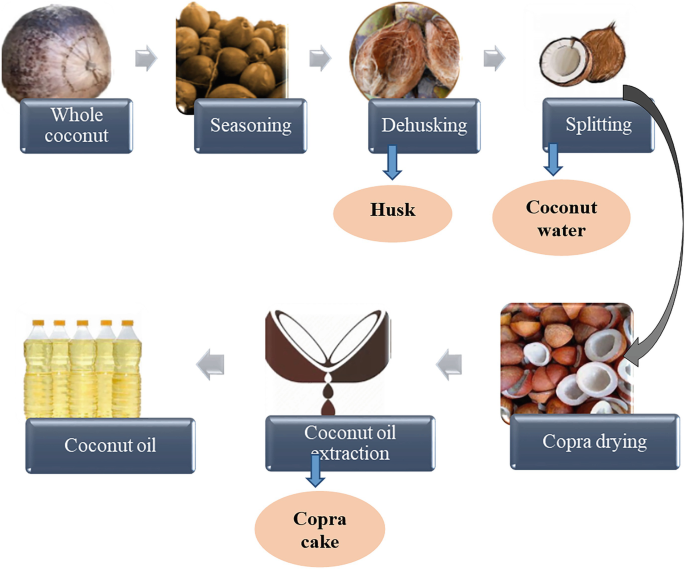
1. Harvesting and Preparation (The Foundation)
Regardless of the final oil type, the process always starts at the farm:
- Harvesting: Workers gather fully matured, brown coconuts from tall coconut palms using long poles or climbing techniques.
- Husking and Shelling: The thick, fibrous outer husk is pried open using a grounded metal spike. The hard inner brown shell is then cracked open to reveal the white meat.
- Sorting and Cleaning: The coconut meat is washed and thoroughly inspected. Any spoiled, discolored, or damaged pieces are discarded to ensure high quality.
2. Method A: The Dry Process (Refined/RBD Oil)
This is the most common commercial method used to produce the majority of the world's coconut oil.
[Fresh Meat] ➔ [Smoke/Sun Dried to Copra] ➔ [Mechanical Expeller Press] ➔ [RBD Refining]
- Drying (Copra Creation): The fresh coconut meat is dried out using large kilns, smoky fires, or the sun over several days. This dried coconut meat is called copra.
- Expeller Pressing: The copra is fed into high-pressure mechanical expeller presses that crush and squeeze out the crude oil. Because the copra-making process is often exposed to outdoor elements, the resulting crude oil is brown, acidic, and unpalatable.
- Refining, Bleaching, and Deodorizing (RBD): To make it edible, the oil undergoes the RBD process:
- Refining: A weak caustic soda solution removes free fatty acids.
- Bleaching: The oil is filtered through bleaching clays to remove the dark tint.
- Deodorizing: High-heat steam (around 230°C / 446°F) removes the strong coconut aroma and flavor, leaving a neutral, stable cooking oil.
- 3. Method B: The Wet Process (Virgin / Unrefined Oil)
Virgin coconut oil is made from fresh coconut meat rather than dried copra, completely skipping chemical processing and high heat to preserve natural nutrients and aroma. [Fresh Meat] ➔ [Grated & Pressed] ➔ [Coconut Milk] ➔ [Centrifuge / Fermentation] ➔ [Pure Oil]
- Milk Extraction: Fresh coconut meat is finely grated and mixed with a small amount of water. It is then compressed to extract rich coconut milk.
- Separation: Since coconut milk is an emulsion of oil and water, producers must separate them using one of these natural techniques:
- Centrifuge Method: The milk is put into a high-speed spinning centrifuge machine. The rapid spinning forces the dense water away, cleanly separating the pure oil from the liquid.
- Fermentation Method: The milk sits in tanks for 24 to 72 hours. Naturally occurring enzymes cause the mixture to separate into distinct layers: a watery bottom layer, a curd-like middle layer, and pure oil floating at the top.
- Chilling/Refrigeration: The milk is chilled until the fat solidifies at the top, making it easy to scoop out and gently warm to remove remaining moisture.
- Separation: Since coconut milk is an emulsion of oil and water, producers must separate them using one of these natural techniques:
- 4. By-Products and Sustainability
Coconut oil extraction is a low-waste industry where almost everything is reused:- Copra Meal / Pulp: The leftover grated coconut pulp after pressing is dried and repurposed into high-fiber animal feed or processed into gluten-free coconut flour.
- Husks and Shells: Used as a natural fuel source to power the factory's drying kilns or processed into activated charcoal and industrial fibers.
Comments (0)
No comments yet. Be the first to share your thoughts.