Polynomials are algebraic expressions composed of variables and coefficients, utilizing only addition, subtraction, multiplication, and non-negative integer exponents. They are classified into two main categories: by the number of terms and by the degree (highest exponent).
Classification by Number of Terms/Variables
Terms/variables separated by addition or subtraction of variables
Monomial: Contains exactly 1 term. Example:
Binomial: Contains exactly 2 terms. Example: 3x and 5
Multinomial: Contains 4 or more terms. Example: x³ + 2y² - 4z + 5
Classification by Degree
Constant (or Zero) Polynomial: (P(x) = 5). The highest power of the variable (like (x⁰)) is 0, making its degree zero.
Linear Polynomial: P(x) = ax + b
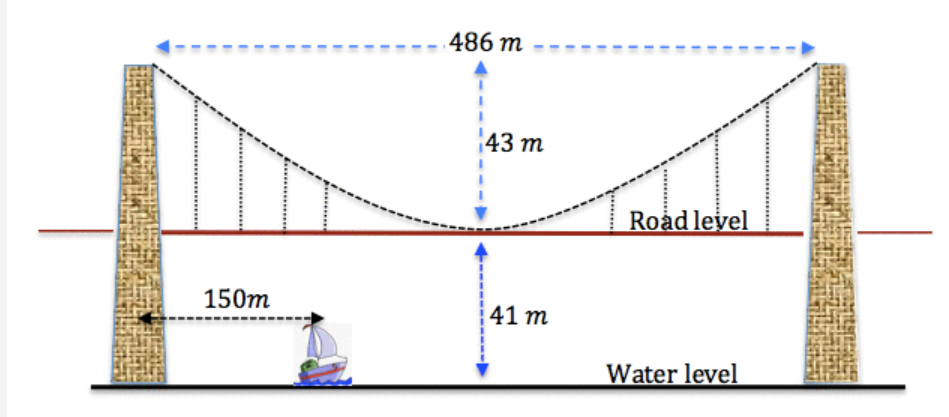
Quadratic Polynomial: It takes the general form P(x) = ax² + b,
Cubic Polynomial: takes the power of 3 P(x) = ax³ + bx² + cx + d
Quartic Polynomial: A quartic polynomial is a mathematical expression with a highest degree (or exponent) of 4. The general standard form is (ax⁴ + bx³ + cx²+ dx + e = 0)
Quintic Polynomial: The general algebraic form is 𝑓(𝑥)=𝑎𝑥⁵+𝑏𝑥⁴+𝑐𝑥³+𝑑𝑥²+𝑒𝑥 Polynomial Application
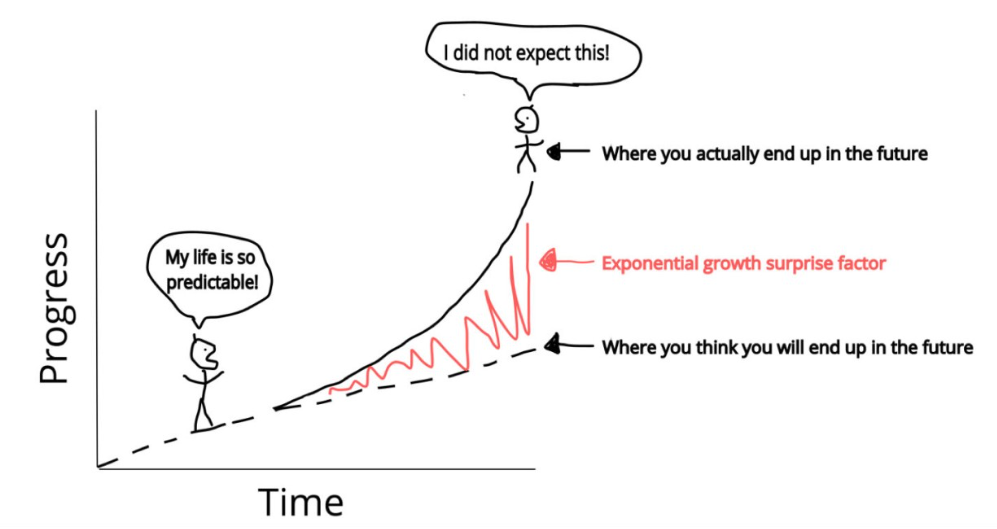
Exponential refers to a relationship or function where a variable is in the exponent (e.g., (y = b^x)). It is defined by a constant rate of change that is proportional to the current value, resulting in a curve that starts slowly but increases or decreases extremely rapidly
Mathematical Definition
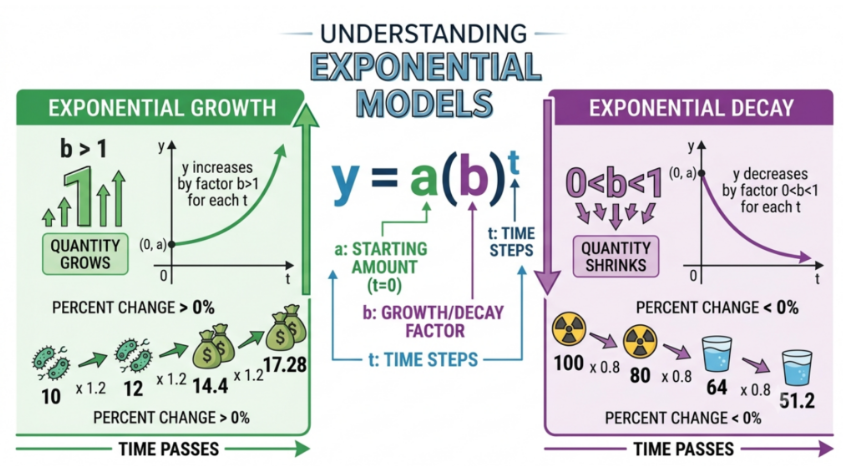
An exponential function is generally written in the form (f(x) = a + bⁿ), where:
a: The initial value or starting point (the y-intercept).
b: The base of the exponent (a positive number not equal to 1).
x: The variable (often representing time).
This base is used to model continuous processes like compound interest, radioactive decay, and population growth because its rate of change is directly proportional to its current value
Exponential Growth vs. Decay
The behavior of the function depends largely on the base number:
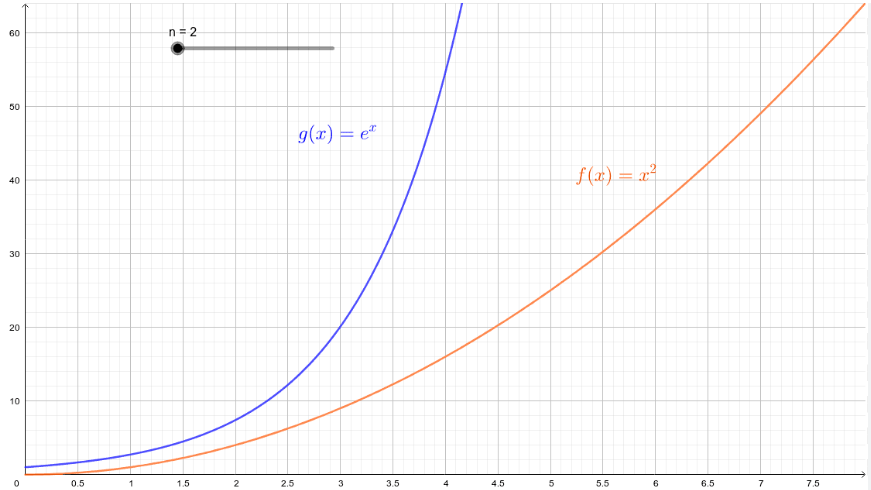
Exponential Growth (b > 1): The function increases more and more rapidly as x increases. Examples include compound interest, bacteria reproducing, or viral spread.
Exponential Decay (0 < b < 1): The function decreases rapidly toward zero as x increases. This is commonly seen in radioactive decay or the depreciation of a vehicle's value.
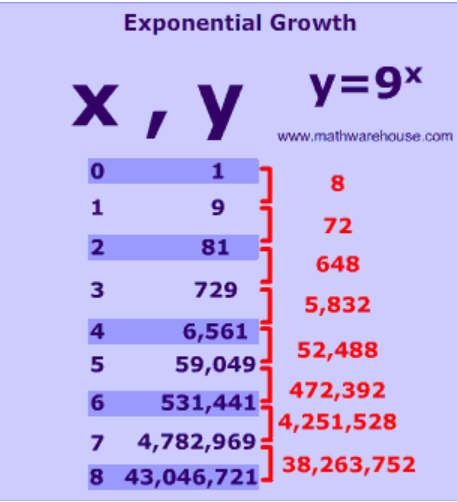
People often confuse exponential growth with linear growth, but the difference is massive over time:
Linear growth increases by a set, fixed amount each step (e.g., +2, +2, +2).
Exponential growth is a pattern of increase where a quantity grows at a rate proportional to its current size. Because the growth rate is constantly applied to an ever-increasing total, the value multiplies over time rather than just adding a fixed number, forming an accelerating,
Finance: Compound interest causes wealth to grow exponentially. If a $1,000 investment grows at a fixed 10% annual rate, the interest you earn each year also begins to earn interest, eventually leading to massive long-term gains.
Biology: In environments without resource limits, bacterial populations or unchecked invasive species grow exponentially. The population doubles at a regular interval because every new organism can reproduce.
Epidemiology: The spread of a contagious virus starts slowly but can become exponential as infected individuals pass the pathogen to multiple other people, creating a rapid surge in total cases.
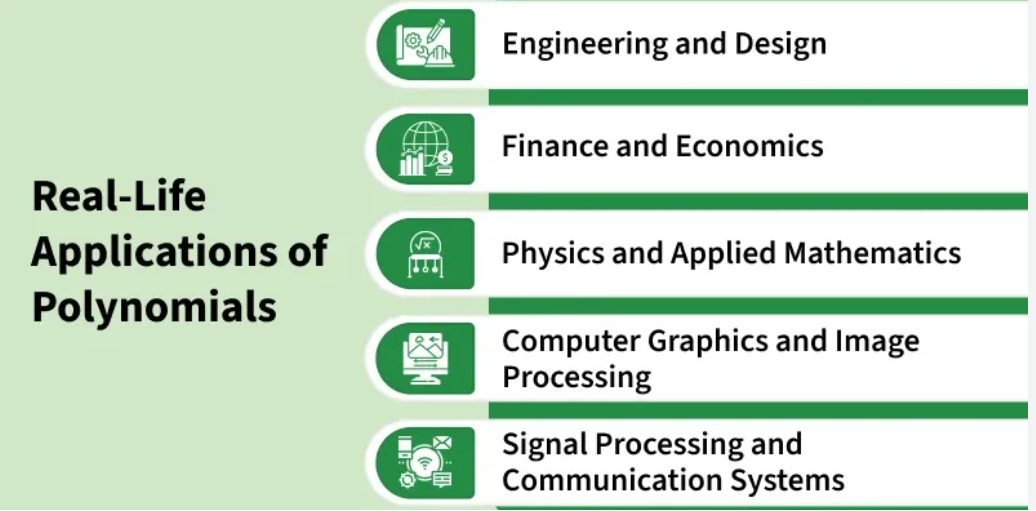
Polynomial functions (like (f(x) = axⁿ)) and exponential functions (like (f(x) = ab^x)) are cornerstones of mathematical modeling. Polynomials typically model physical curves, supply/demand data, and geometric volumes, while exponentials are used for continuous growth, decay, and optimization
Exponentials are used when the rate of change is directly proportional to the current amount of the substance, leading to explosive growth or rapid decay. Key applications include:
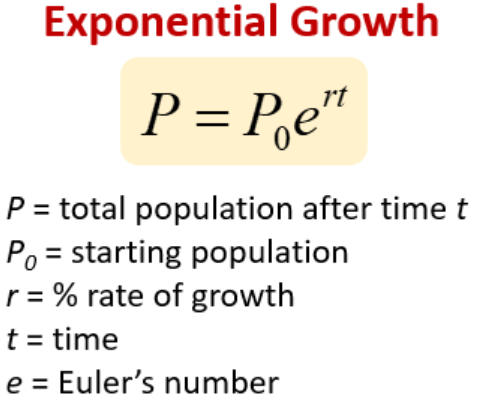
Finance: The compounding interest formula is the most common real-world application, represented as $A = P(1 + \frac{r}{n})^{nt}\( [0.5.4]. For example, investing \)$1,000 at a 5% annual rate compounded continuously uses Euler's number (e) in the formula (A = Pe^{rt}), allowing you to calculate the future value of an account over any timeframe.
Biology & Demographics: Bacterial cultures or unregulated human populations grow proportionally to their current size, modeled by (N(t) = N_0e^{rt}).
Medicine & Geology: Radiometric dating and pharmaceutical clearance times rely on exponential decay. The decay of Carbon-14 in fossils is given by (P(t) = P_0e^{-kt}), where (k) is the specific decay constant for the isotope.
Polynomial Applications
Polynomials describe situations where rates of change vary depending on current conditions. Common examples include:
Physics & Engineering: Projectile motion requires quadratic polynomials (degree 2) to calculate the height of an object over time. For example, a rock thrown downward with an initial velocity in meters per second (v{0}) from an initial height (h{0}) is modeled by (h(t) = -4.9t² + v0t + h0).
Economics: Cost functions in manufacturing frequently use cubic to model the economies and diseconomies of scale as production increases, capturing fixed and variable costs.
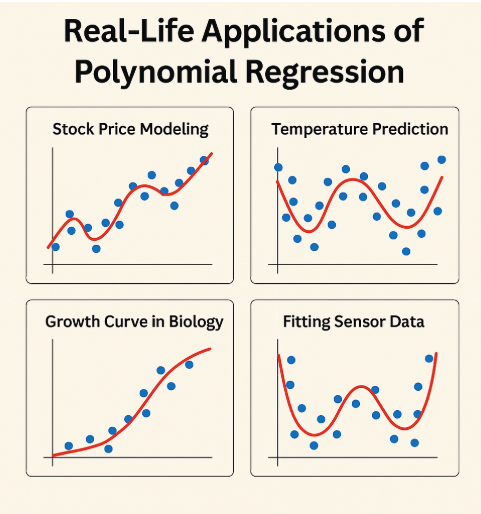
Data Modeling: Complex, irregular datasets—such as traffic flow density or consumer trends—are often approximated using higher-degree polynomials (e.g., (f(x) = ax³ + bx² + cx + d)) to create smooth, continuous lines of best fit.
Comments (0)
No comments yet. Be the first to share your thoughts.