Education
The art of Simplification : Finding Solutions to Problems
September 6, 2026 · 40 views ·by Odeyemi Oluwafemi
⇒ the art of simplification
⇒from observation to algorithm solution
"The ability to simplify means to eliminate the unnecessary so that the necessary may speak." — Hans Hofmann
"Simplicity is the ultimate sophistication." — Leonardo da Vinci
Confucius: “Life is really simple, but we insist on making it complicated.”
The art of simplification is the ultimate strategy for finding solutions to problems, acting as a powerful antidote to cognitive overload and analysis paralysis. True simplification does not mean oversimplifying or stripping away vital nuances; rather, it means digging deeper into a complex situation to isolate its core elements so you can address them without unnecessary friction.
The art of simplification means reducing a complex problem to its essential core to find a clear and effective solution.
Whether you are debugging code, analyzing a business strategy, or solving a mathematical equation, breaking down a problem into its cleanest, most manageable components allows you to allocate limited cognitive resources efficiently.

Core Frameworks for Problem Simplification
1. Value-Guided Construal (Psychology)
In cognitive psychology, Value-Guided Construal is the mechanism by which human minds dynamically filter out irrelevant operational details to save processing power.
- The Strategy: Build a "base model" of your problem containing only the absolute essentials. Solve this easiest variation first, and only introduce layers of real-world obstacles or secondary details once the primary logic holds.
2. Strategic Decomposition (Mathematics & Engineering)
When a system or equation presents too many moving parts to solve in a single leap, breaking it down into symmetrical sub-problems keeps it manageable.
- The Strategy: Reframe the scenario using smaller numbers, look for recurring structural patterns, or isolate symmetrical variables. In mathematics, tools like the BODMAS rule enforce a strict order of operations, proving that external clutter disappears when complex networks are reduced to foundational building blocks.
3. Contextual Interconnection (Organizational Strategy)
In systems design and corporate structuring, simplification requires a deep understanding of downstream dependencies. As highlighted by design experts, you must know what connects to what before deciding what to eliminate.
- The Strategy: Map how the problem connects to the rest of the ecosystem. This prevents you from oversimplifying to the point of breaking critical dependencies, ensuring that the final solution remains grounded in practical reality.
Finding effective solutions to a problem requires a clear, step-by-step approach that moves from understanding the core issue to executing and reviewing a fix.
1. Define and Clarify the Problem
Write it down: Clearly state what is wrong in writing. A precise definition prevents you from wasting time on secondary issues.
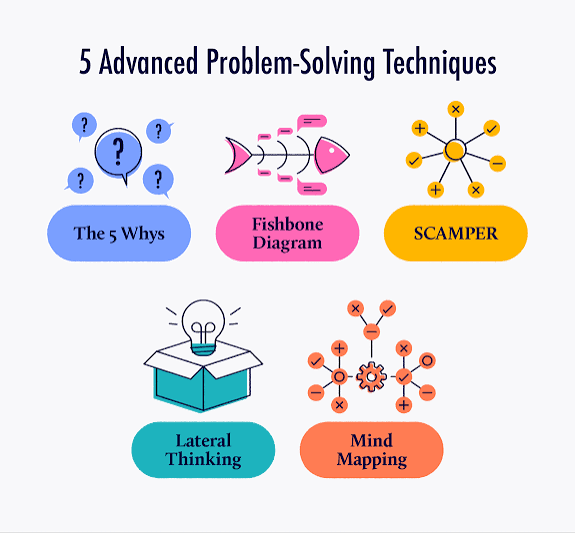
Find the root cause: Ask "why" multiple times (the 5 Whys technique) to discover why the issue happens instead of just treating the symptoms.
2. Brainstorm Solutions
Generate ideas freely: Write down as many potential solutions as possible without judging them too early.
Look outside your normal scope: Simplify the problem, ask people from different fields, or check how other industries handle similar challenges.
3. Choose and Plan
Evaluate feasibility: Pick the option that is realistic, fits your available resources and time, and solves the root cause without creating new negative outcomes.
Set a deadline: Give yourself or your team a clear timeline for execution to maintain focus and urgency.
4. Take Action and Evaluate
Implement the fix: Execute the chosen plan step by step.
Track and reflect: Review the results to see if the problem is resolved, and adjust your approach if it happens again

Key Steps to Simplify Problems
Find the raw truth: Get the full picture before relying on pre-filtered summaries or expert assumptions.
Remove the non-essential: Strip away extra details, jargon, and anything that does not directly impact your goal.
Break down complexity: Divide large, overwhelming tasks into small, manageable pieces.
Use rules for structure: Apply logical sequences—like order of operations in math or step-by-step logic in reasoning—to make manipulation easier.

Comments (0)
No comments yet. Be the first to share your thoughts.