Business
THE PSYCHOLOGY OF “JUST ₦9,999”
August 18, 2026 · 11 views ·by Emma-Golden
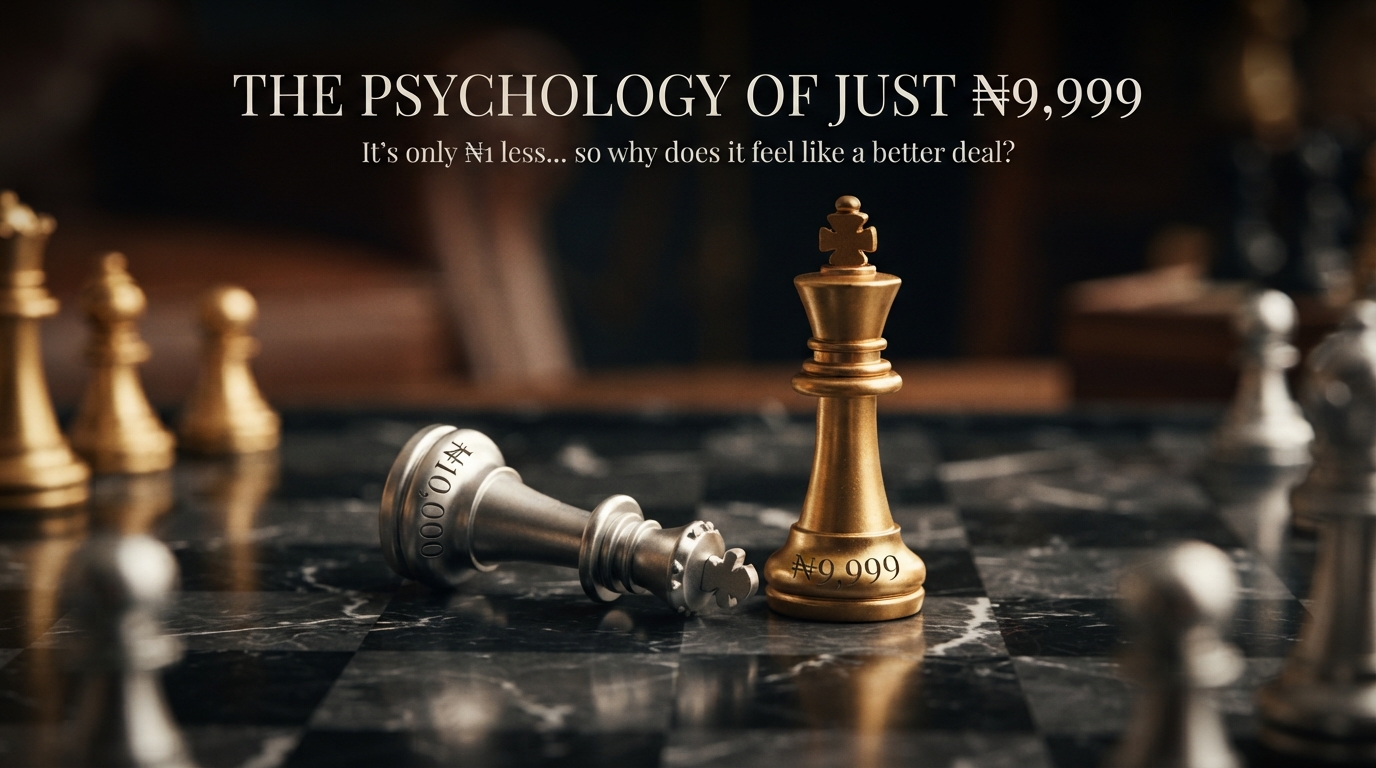
THE PSYCHOLOGY OF “JUST ₦9,999”
Have you ever looked at a product priced at ₦9,999 and thought, “That’s basically ₦10,000”?
Of course it is.
But somehow, ₦9,999 feels different.
That tiny ₦1 difference is almost meaningless financially, yet businesses have been using pricing techniques like this for decades because how we see a price can influence how we feel about buying it.
This is where psychology enters the business of pricing.
THE MAGIC OF THE LEFT DIGIT
One reason ₦9,999 can feel cheaper than ₦10,000 is that consumers tend to pay attention to the first digit when processing a price.
₦9,999 begins with 9.
₦10,000 begins with 10.
Even though the actual difference is only ₦1, the first impression can make the two prices feel psychologically different.
This is sometimes called charm pricing or psychological pricing.
The same principle appears everywhere:
₦4,999 instead of ₦5,000.
₦19,999 instead of ₦20,000.
₦49,999 instead of ₦50,000.
The business isn't necessarily changing the product.
It is changing the way the price is presented.
WE DON'T ALWAYS SHOP WITH A CALCULATOR
Consumers like to believe that purchasing decisions are completely rational.
They aren't.
We consider price, quality, convenience, reputation and personal preference — but emotions and mental shortcuts also influence our decisions.
Imagine seeing two identical-looking products:
Product A — ₦10,000
Product B — ₦9,999
You already know the difference is practically nothing.
Yet Product B can feel like the better deal.
That feeling matters.
Businesses aren't only selling products. They're also managing perception.
THE “DEAL” FEELING
Pricing can also influence whether customers feel like they're getting value.
Consider a product originally displayed at ₦20,000 and now offered at ₦14,999.
The customer doesn't only see ₦14,999.
They see:
“I am saving ₦5,001.”
The comparison creates a reference point.
Suddenly, the new price feels more attractive because the customer is evaluating it against the previous price.
This is one reason discounts are so powerful when they're genuine and clearly communicated.
BUT PSYCHOLOGICAL PRICING ISN'T MAGIC
Putting .99 at the end of every price doesn't automatically make a business successful.
Customers are becoming smarter.
If the product is poor, customer service is terrible and the brand doesn't deliver on its promises, ₦9,999 won't save it.
A clever price may attract attention.
Value is what keeps the customer.
Businesses therefore have to understand the difference between making something look affordable and actually making it worth the money.
WHAT BUSINESSES CAN LEARN
Pricing isn't simply about calculating production costs and adding profit.
It is also about understanding how customers perceive value.
The right question isn't only:
“How much should we charge?”
It should also be:
“How will our customer perceive this price?”
Because sometimes, the difference between a price that gets ignored and one that gets considered isn't thousands of naira.
Sometimes, it's just ₦1.
THE BUSINESS TAKEAWAY
Good pricing isn't about tricking customers.
It's about understanding the psychology behind decision-making and communicating value clearly.
Because customers don't experience prices as numbers alone.
They experience them as feelings, comparisons and perceived value.
And that's why ₦9,999 will probably keep looking different from ₦10,000 — even when your calculator says otherwise.
Comments (0)
No comments yet. Be the first to share your thoughts.