Education
THE SILENT CRISIS IN EDUCATION
July 16, 2026 · 10 views
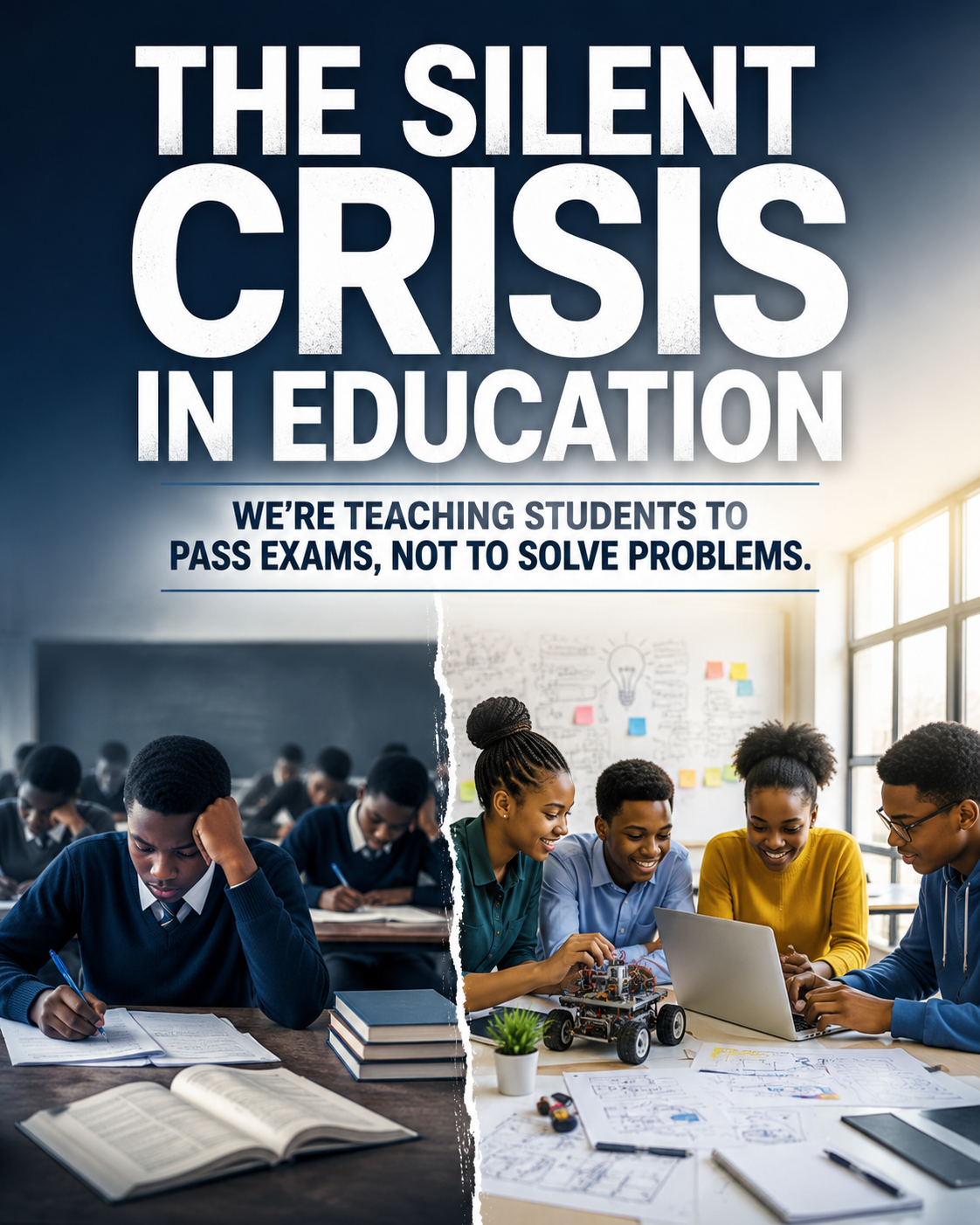
The Silent Crisis in Education
We're Teaching Students to Pass Exams, Not to Solve Problems
The Question Many People Are Afraid to Ask
For decades, academic success has been measured by test scores, grades, and certificates. Parents celebrate distinctions, schools advertise outstanding examination results, and students are taught that passing exams is the ultimate goal.
But beyond the classroom walls, a different reality is waiting.
Many graduates enter the real world with impressive transcripts yet feel unprepared for basic life demands: communicating effectively, managing finances, working in teams, adapting to change, or solving unfamiliar problems without being given the exact answer beforehand.
This is the silent crisis in education. We have become very good at producing students who can remember information for an examination, but not consistently successful at producing young people who can use knowledge to improve their lives and their communities.
The Difference Between Passing and Learning
Passing an exam often requires short-term preparation. Learning requires understanding, application, and reflection.
A student may memorize a biology definition and reproduce it perfectly in an exam hall. But can that same student explain a health issue to a family member in simple language?
Can they use scientific thinking to evaluate misinformation online?
Real learning happens when knowledge becomes a tool, not just a memory exercise.
A Simple Example
Imagine two students:
Student A – Exam-Focused
Memorizes formulas and past questions, scores 92% in mathematics, but struggles to apply the formula to a new situation.
Student B – Learning-Focused
Understands why the formula works, asks questions, and can apply it to budgeting, measurements, business calculations, or data analysis even if the exam question looks unfamiliar.
The second student may or may not score the highest mark, but they are often better equipped for life after school.
Why the World Is Changing Faster Than the Classroom
Technology is evolving at an extraordinary pace. Artificial intelligence can now answer questions, summarize documents, generate ideas, and assist with research. Information is no longer scarce; it is everywhere.
Because of this, the most valuable skill is no longer the ability to store information, but the ability to find, evaluate, and apply information wisely.
Today's students need:
Critical thinking
Creativity
Communication skills
Collaboration
Digital literacy
Emotional intelligence
Financial literacy
Adaptability
Ethical decision-making
These are the skills that help people thrive in careers, relationships, entrepreneurship, and leadership.
The Hidden Cost of an Exam-Only System
When students are taught that grades are everything, several dangerous things can happen.
Fear of Failure
Many students become afraid to try new ideas because mistakes may reduce their scores. Yet innovation is built on experimentation.
Loss of Curiosity
Children naturally ask questions. But in some classrooms, students learn that asking too many questions slows down the lesson. Over time, curiosity is replaced by silence.
Mental Exhaustion
Students may spend years under intense pressure, studying mainly to satisfy external expectations. Some eventually lose motivation for learning altogether.
Dependence on Instructions
In real life, problems rarely come with step-by-step instructions. Employers and communities need people who can think independently, identify problems, and propose solutions.
What Employers Are Really Looking For
A growing number of employers say they can train technical skills, but they struggle to find people who can communicate clearly, work with others, and think through problems.
Traditional Focus Modern Workplace Need
Memorization Critical thinking
Working alone Collaboration
Following instructions Initiative
Avoiding mistakes Learning from mistakes
Exam performance Problem-solving ability
A certificate may open the first door, but skills, character, and adaptability determine how far a person goes afterward.
So, What Should Schools Do Differently?
This is not a call to abolish examinations. Assessment is important. Students should still learn mathematics, science, languages, and other academic subjects. The real issue is balance.
1. Teach Students How to Think
Instead of only asking students to repeat facts, teachers can ask:
Why do you think this happened?
What evidence supports your answer?
Can you think of another solution?
How would you explain this to a younger student?
These questions develop reasoning and confidence.
2. Use Project-Based Learning
Students could work on real community problems such as:
Designing a simple water-saving system
Creating a recycling campaign
Developing a small business plan
Conducting a survey on health or education challenges
Building a basic digital product or awareness campaign
Projects teach research, teamwork, communication, and leadership.
3. Introduce Life Skills
Every student should leave school with a basic understanding of:
Budgeting and saving
Writing a CV and cover letter
Public speaking
Conflict resolution
Time management
Online safety and digital responsibility
Entrepreneurship
These are not "extra" skills; they are survival skills.
4. Reward Creativity, Not Just Correct Answers
A student who proposes a thoughtful but imperfect solution should be encouraged, not dismissed. Creativity grows when students feel safe to think differently.
The Role of Parents
Parents also have a powerful role to play.
Ask your child questions that go beyond "What did you score?"
Try asking:
What did you learn today?
What problem did you solve?
What was the most interesting thing you discovered?
If you were the teacher, how would you explain that topic?
How can this lesson help in real life?
These conversations help children see education as a journey of growth, not just a competition for marks.
A New Definition of an Educated Person
Perhaps it is time to redefine what it means to be educated.
An educated person is not someone who has memorized the most facts. An educated person is someone who can:
Think critically
Learn continuously
Communicate clearly
Treat others with empathy
Adapt to change
Solve problems ethically
Use knowledge to make life better for themselves and others
That is the kind of education the future demands.
Key Takeaways
Exams are important, but they should not be the ultimate goal of education.
Critical thinking and problem-solving are becoming more valuable than memorization.
Students need life skills such as communication, financial literacy, and digital literacy.
Schools should combine academic excellence with practical, real-world learning.
Parents should celebrate learning and growth, not only high scores.
Conclusion
The world does not simply need more students who can pass examinations. It needs thinkers, creators, innovators, compassionate leaders, and problem-solvers.
If education remains focused only on grades, we may continue producing young people who look successful on paper but feel lost when faced with real-life challenges.
But if schools, teachers, parents, and policymakers choose to value understanding over memorization and growth over mere performance, we can raise a generation that is not only academically sound but also capable of building a better future.
The question is no longer, "How many students passed?"
The more important question is:
"How many students are truly prepared to solve the challenges of tomorrow?"
Your Part
If you are a teacher, introduce one activity this term that requires students to think, create, or solve a real problem.
If you are a parent, have one conversation this week that focuses on what your child learned, not just the score they brought home.
If you are a student, challenge yourself to understand why a concept works, not just what to write in the exam.
Education must move from memorizing answers to discovering solutions.
Further Reading
UNICEF – https://www.unicef.org/education
We're Teaching Students to Pass Exams, Not to Solve Problems
The Question Many People Are Afraid to Ask
For decades, academic success has been measured by test scores, grades, and certificates. Parents celebrate distinctions, schools advertise outstanding examination results, and students are taught that passing exams is the ultimate goal.
But beyond the classroom walls, a different reality is waiting.
Many graduates enter the real world with impressive transcripts yet feel unprepared for basic life demands: communicating effectively, managing finances, working in teams, adapting to change, or solving unfamiliar problems without being given the exact answer beforehand.
This is the silent crisis in education. We have become very good at producing students who can remember information for an examination, but not consistently successful at producing young people who can use knowledge to improve their lives and their communities.
The Difference Between Passing and Learning
Passing an exam often requires short-term preparation. Learning requires understanding, application, and reflection.
A student may memorize a biology definition and reproduce it perfectly in an exam hall. But can that same student explain a health issue to a family member in simple language?
Can they use scientific thinking to evaluate misinformation online?
Real learning happens when knowledge becomes a tool, not just a memory exercise.
A Simple Example
Imagine two students:
Student A – Exam-Focused
Memorizes formulas and past questions, scores 92% in mathematics, but struggles to apply the formula to a new situation.
Student B – Learning-Focused
Understands why the formula works, asks questions, and can apply it to budgeting, measurements, business calculations, or data analysis even if the exam question looks unfamiliar.
The second student may or may not score the highest mark, but they are often better equipped for life after school.
Why the World Is Changing Faster Than the Classroom
Technology is evolving at an extraordinary pace. Artificial intelligence can now answer questions, summarize documents, generate ideas, and assist with research. Information is no longer scarce; it is everywhere.
Because of this, the most valuable skill is no longer the ability to store information, but the ability to find, evaluate, and apply information wisely.
Today's students need:
Critical thinking
Creativity
Communication skills
Collaboration
Digital literacy
Emotional intelligence
Financial literacy
Adaptability
Ethical decision-making
These are the skills that help people thrive in careers, relationships, entrepreneurship, and leadership.
The Hidden Cost of an Exam-Only System
When students are taught that grades are everything, several dangerous things can happen.
Fear of Failure
Many students become afraid to try new ideas because mistakes may reduce their scores. Yet innovation is built on experimentation.
Loss of Curiosity
Children naturally ask questions. But in some classrooms, students learn that asking too many questions slows down the lesson. Over time, curiosity is replaced by silence.
Mental Exhaustion
Students may spend years under intense pressure, studying mainly to satisfy external expectations. Some eventually lose motivation for learning altogether.
Dependence on Instructions
In real life, problems rarely come with step-by-step instructions. Employers and communities need people who can think independently, identify problems, and propose solutions.
What Employers Are Really Looking For
A growing number of employers say they can train technical skills, but they struggle to find people who can communicate clearly, work with others, and think through problems.
Traditional Focus Modern Workplace Need
Memorization Critical thinking
Working alone Collaboration
Following instructions Initiative
Avoiding mistakes Learning from mistakes
Exam performance Problem-solving ability
A certificate may open the first door, but skills, character, and adaptability determine how far a person goes afterward.
So, What Should Schools Do Differently?
This is not a call to abolish examinations. Assessment is important. Students should still learn mathematics, science, languages, and other academic subjects. The real issue is balance.
1. Teach Students How to Think
Instead of only asking students to repeat facts, teachers can ask:
Why do you think this happened?
What evidence supports your answer?
Can you think of another solution?
How would you explain this to a younger student?
These questions develop reasoning and confidence.
2. Use Project-Based Learning
Students could work on real community problems such as:
Designing a simple water-saving system
Creating a recycling campaign
Developing a small business plan
Conducting a survey on health or education challenges
Building a basic digital product or awareness campaign
Projects teach research, teamwork, communication, and leadership.
3. Introduce Life Skills
Every student should leave school with a basic understanding of:
Budgeting and saving
Writing a CV and cover letter
Public speaking
Conflict resolution
Time management
Online safety and digital responsibility
Entrepreneurship
These are not "extra" skills; they are survival skills.
4. Reward Creativity, Not Just Correct Answers
A student who proposes a thoughtful but imperfect solution should be encouraged, not dismissed. Creativity grows when students feel safe to think differently.
The Role of Parents
Parents also have a powerful role to play.
Ask your child questions that go beyond "What did you score?"
Try asking:
What did you learn today?
What problem did you solve?
What was the most interesting thing you discovered?
If you were the teacher, how would you explain that topic?
How can this lesson help in real life?
These conversations help children see education as a journey of growth, not just a competition for marks.
A New Definition of an Educated Person
Perhaps it is time to redefine what it means to be educated.
An educated person is not someone who has memorized the most facts. An educated person is someone who can:
Think critically
Learn continuously
Communicate clearly
Treat others with empathy
Adapt to change
Solve problems ethically
Use knowledge to make life better for themselves and others
That is the kind of education the future demands.
Key Takeaways
Exams are important, but they should not be the ultimate goal of education.
Critical thinking and problem-solving are becoming more valuable than memorization.
Students need life skills such as communication, financial literacy, and digital literacy.
Schools should combine academic excellence with practical, real-world learning.
Parents should celebrate learning and growth, not only high scores.
Conclusion
The world does not simply need more students who can pass examinations. It needs thinkers, creators, innovators, compassionate leaders, and problem-solvers.
If education remains focused only on grades, we may continue producing young people who look successful on paper but feel lost when faced with real-life challenges.
But if schools, teachers, parents, and policymakers choose to value understanding over memorization and growth over mere performance, we can raise a generation that is not only academically sound but also capable of building a better future.
The question is no longer, "How many students passed?"
The more important question is:
"How many students are truly prepared to solve the challenges of tomorrow?"
Your Part
If you are a teacher, introduce one activity this term that requires students to think, create, or solve a real problem.
If you are a parent, have one conversation this week that focuses on what your child learned, not just the score they brought home.
If you are a student, challenge yourself to understand why a concept works, not just what to write in the exam.
Education must move from memorizing answers to discovering solutions.
Further Reading
UNICEF – https://www.unicef.org/education
Comments (0)
No comments yet. Be the first to share your thoughts.