Education
Rule Based Knowledge : what is the value of zero (0), 0⁰ =1 but 0⁵ =0
July 21, 2026 · 7 views
Zero was invented in India, but what is the value of zero ?
Around the 5th century CE, the Indian mathematician and astronomer Aryabhata used a symbol for zero in his astronomical calculations. However, it was Brahmagupta, another Indian mathematician, who formalized the use of zero in 628 CE.
Around the 5th century CE, the Indian mathematician and astronomer Aryabhata used a symbol for zero in his astronomical calculations. However, it was Brahmagupta, another Indian mathematician, who formalized the use of zero in 628 CE.
Aryabhata, the Mathematician and astronomer is actually the founder of zero
From India, the concept of zero traveled through Islamic mathematician ( Mūsā al-Khwārizmī ) to Europe when Italian Fibonacci introduced it in his book called Liber Abaci
The value of zero fundamentally depends on its context, ranging from an absolute null quantity to a critical structural marker in logic and computing.
The value of zero fundamentally depends on its context, ranging from an absolute null quantity to a critical structural marker in logic and computing.
Depending on the domain, its value and meaning are as follows:
Mathematics: Zero's value is nil (representing nothing or the absence of quantity). However, it acts as a crucial "additive identity" (e.g., (x + 0 = x)) and a placeholder that gives other digits their proper place value (e.g., distinguishing 10 from 100).
Rule-Based Systems & AI(artificial intelligence): In classical rule engines, if-then heuristics evaluate expressions to true or false (which is often assigned a numeric value of (0)).
Fuzzy Logic & Knowledge Bases: In fuzzy systems, zero is used as a degree of membership to denote complete non-membership. It indicates that an element strictly does not belong to a specific category, set, or rule.
The exact value of the number (0) is an empty quantity or nothing. It is mathematically defined as an integer, a whole number, and a neutral real number.
The behavior and properties of (0) depend on the operation being performed:
In mathematical contexts like algebra, combinatorics, and computer science, (0⁰) is defined as (1) because it keeps fundamental mathematical rules, polynomial formulas, and counting principles consistent.
In mathematical contexts like algebra, combinatorics, and computer science, (0⁰) is defined as (1) because it keeps fundamental mathematical rules, polynomial formulas, and counting principles consistent.
- Addition & Subtraction: Adding or subtracting (0) to any number leaves that number unchanged. ((a + 0 = a))
- Multiplication: Multiplying any number by (0) results in (0). ((a times 0 = 0))
- Division: Dividing (0) by any non-zero number is (0), but dividing any number by (0) is undefined. (("a" divided by "0") is undefined)
- Powers: Any non-zero number raised to the power of (0) is (1).
- The mathematical expression (0⁰) is generally considered indeterminate depending on the context.
- Factorial: The factorial of (0) is (1) ((0! = 1)) because there is exactly one way to arrange an empty set.
The mathematical expression
5⁰=1 is
because it maintains consistency in the rules of division and multiplication patterns.
The Division Rule
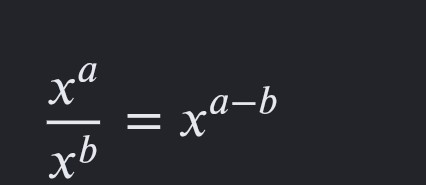
The quotient rule for exponents states that when dividing terms with the same base, you subtract the exponents:
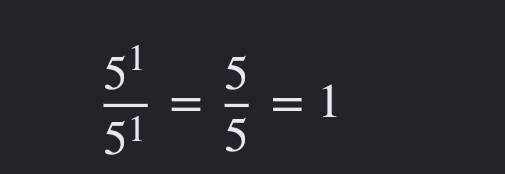
- Using basic division: Any non-zero number divided by itself equals
:
Division to rules - Using the exponent rule: Subtracting the exponents gives:
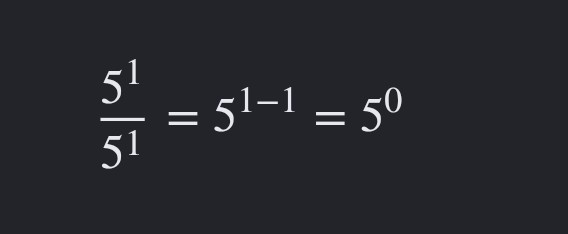
Exponential rules
Since both methods solve the exact same equation, 5⁰
must equal 1
.
must equal 1
.
Conclusion
Any non-zero base raised to the power of zero is equal to 1
because it satisfies the foundational patterns and rules of mathematics.
because it satisfies the foundational patterns and rules of mathematics.
Without this set of rule-based knowledge, modern computing, the binary system, and digital logic would not be possible.
It changes how we view nothingness and absence, which could have been the void that exists in mathematical philosophy
.
It changes how we view nothingness and absence, which could have been the void that exists in mathematical philosophy
.
Comments (0)
No comments yet. Be the first to share your thoughts.