Education
WILL AI REPLACE YOU⁉️
July 16, 2026 · 16 views
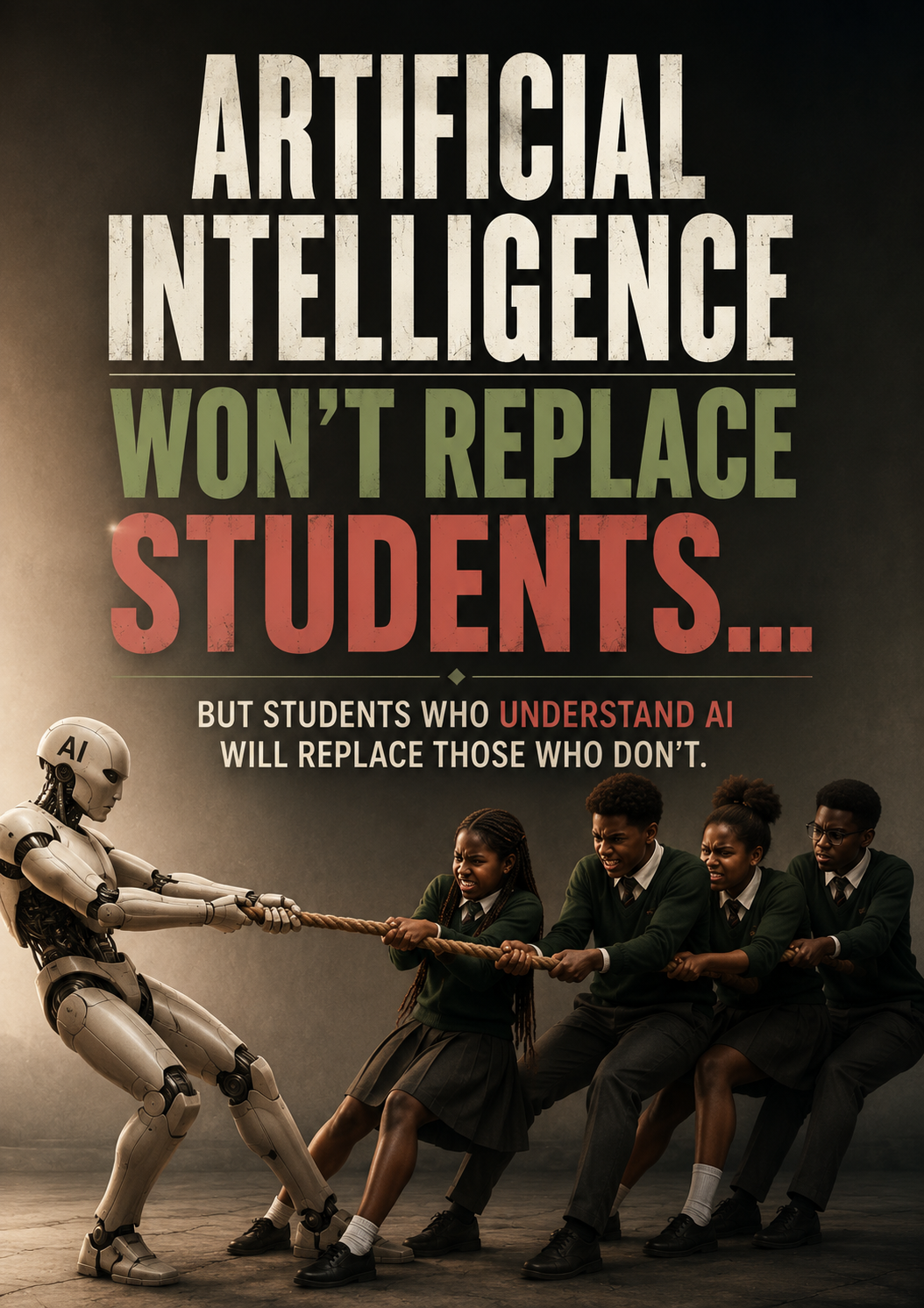
Artificial Intelligence Won't Replace Students
But Students Who Understand AI Will Replace Those Who Don't
The Future Doesn't Belong to Those Who Know the Most, It Belongs to Those Who Learn the Fastest.
The Biggest Classroom Revolution Has Already Begun
Imagine walking into a classroom where one student uses Artificial Intelligence to summarize a 200-page textbook in minutes, another uses it to learn coding from scratch, and another relies on it to prepare for an interview. Across the room, a student refuses to use AI because they believe it's "just cheating."
Now ask yourself this question:
Ten years from now, which student is more likely to thrive?
Artificial Intelligence (AI) is no longer a concept reserved for science fiction. It has quietly become part of our daily lives. From voice assistants and translation apps to personalized learning platforms and career tools, AI is transforming how we live, work, and learn.
Yet, despite its growing presence, many people still misunderstand what AI means for education. Some fear it will replace teachers. Others worry it will make students lazy. While these concerns deserve attention, they overlook a more important reality:
AI is not replacing education, it is reshaping it.
The greatest risk is not that AI will take students' opportunities. The greatest risk is that students who refuse to understand AI may struggle to compete with those who do.
What Is Artificial Intelligence?
Artificial Intelligence refers to computer systems designed to perform tasks that normally require human intelligence. These tasks include understanding language, recognizing patterns, solving problems, generating ideas, translating languages, and even creating music or artwork.
Many students already use AI without realizing it. Every time they receive movie recommendations, use a grammar checker, search online with smart suggestions, or ask a virtual assistant a question, they are interacting with AI.
The real question is no longer whether AI will become part of education.
It already has.
AI Is a Tool, Not a Replacement for Learning
One of the biggest misconceptions about AI is that it does all the thinking for students.
It doesn't.
AI can provide information, but it cannot replace curiosity.
It can generate ideas, but it cannot replace creativity.
It can answer questions, but it cannot replace wisdom.
Think of AI as a calculator. Calculators did not eliminate mathematics; they changed how mathematics was taught. Students still needed to understand concepts, solve problems, and apply logic.
In the same way, AI should be viewed as a learning partner rather than a shortcut.
Students who use AI responsibly can:
Understand difficult concepts more quickly.
Practice writing and communication.
Learn new languages.
Prepare for interviews.
Explore career options.
Brainstorm creative ideas.
Receive personalized explanations at their own pace.
The key is to use AI to support learning, not replace it.
The Skills AI Cannot Replace
As powerful as AI has become, there are qualities that remain deeply human.
Critical Thinking
AI can provide answers, but it cannot always determine whether those answers are accurate or appropriate. Students must learn to question information, verify facts, and evaluate different perspectives.
Creativity
AI can generate content based on existing patterns, but original ideas often come from human imagination, personal experiences, and emotional insight.
Emotional Intelligence
Machines can simulate empathy, but they cannot genuinely understand human emotions, build trust, or provide authentic compassion.
Leadership
Great leaders inspire people, make ethical decisions, resolve conflicts, and build relationships, qualities that technology cannot fully replicate.
Adaptability
The future belongs to individuals who can learn, unlearn, and relearn as the world changes.
The Danger of Misusing AI
While AI offers enormous benefits, students must also understand its risks.
Using AI to copy assignments without understanding the material may produce good grades in the short term but weakens genuine learning.
Education is not simply about submitting work. It is about developing knowledge, confidence, and independent thinking.
Responsible AI use means:
Verifying information from reliable sources.
Citing AI assistance when required.
Using AI to learn, not to deceive.
Thinking critically instead of accepting every answer automatically.
Technology should strengthen education, not weaken academic integrity.
Teachers Are More Important Than Ever
Some people believe AI will replace teachers.
The opposite may be true.
As information becomes easier to access, teachers become even more valuable because they guide students in understanding, evaluating, and applying knowledge.
A teacher does much more than deliver facts.
Teachers inspire confidence.
They encourage curiosity.
They identify students' strengths.
They mentor, motivate, and shape character.
No machine can replace the human connection between an inspiring teacher and a determined learner.
How Schools Should Prepare Students
To remain relevant in the age of AI, schools should embrace technology while strengthening human-centered education.
Schools can:
Teach students how AI works.
Include digital literacy in the curriculum.
Encourage ethical technology use.
Promote project-based learning.
Strengthen communication and teamwork.
Teach students how to verify online information.
Encourage innovation and entrepreneurship.
Education should no longer focus only on remembering facts. It should focus on teaching students how to think, create, adapt, and lead.
Parents Have a Role Too
Parents should not fear AI simply because it is new.
Instead, they should guide their children in using technology responsibly.
Ask questions like:
How did AI help you understand today's lesson?
What did you learn from using it?
Did you verify the information?
Could you explain it in your own words?
These conversations encourage responsible digital habits and lifelong learning.
The Future Belongs to Lifelong Learners
History shows that every technological revolution creates fear before creating opportunity.
The internet changed education.
Smartphones changed communication.
Artificial Intelligence is changing both.
Students who remain curious, adaptable, and committed to continuous learning will discover opportunities that previous generations could only imagine.
The future will not reward those who know everything.
It will reward those who never stop learning.
Key Takeaways
AI is transforming education, not replacing it.
Students should learn how to use AI responsibly and ethically.
Critical thinking, creativity, emotional intelligence, and leadership remain essential human skills.
Teachers continue to play a vital role in guiding learning.
Schools should prepare students for an AI-powered future by combining technology with strong human values.
Conclusion
Artificial Intelligence is one of the greatest educational opportunities of our generation, but only if we choose to use it wisely.
Students who embrace AI as a tool for growth will gain an advantage. Those who ignore it entirely may find themselves unprepared for tomorrow's world.
The goal is not to compete against machines.
The goal is to become the kind of human being that machines can never replace.
Education has always been about preparing young people for the future.
Today, that future has already arrived.
YOUR PART
If you are a student, begin exploring AI as a learning companion, not as a shortcut.
If you are a teacher, introduce your students to ethical AI use and encourage them to ask better questions.
If you are a parent, guide your children to use technology responsibly while reminding them that integrity, curiosity, and character remain their greatest strengths.
The future won't belong to those who fear Artificial Intelligence, it will belong to those who learn how to use it wisely.
Further Readings
UNESCO – https://www.unesco.org/en/artificial-intelligence
But Students Who Understand AI Will Replace Those Who Don't
The Future Doesn't Belong to Those Who Know the Most, It Belongs to Those Who Learn the Fastest.
The Biggest Classroom Revolution Has Already Begun
Imagine walking into a classroom where one student uses Artificial Intelligence to summarize a 200-page textbook in minutes, another uses it to learn coding from scratch, and another relies on it to prepare for an interview. Across the room, a student refuses to use AI because they believe it's "just cheating."
Now ask yourself this question:
Ten years from now, which student is more likely to thrive?
Artificial Intelligence (AI) is no longer a concept reserved for science fiction. It has quietly become part of our daily lives. From voice assistants and translation apps to personalized learning platforms and career tools, AI is transforming how we live, work, and learn.
Yet, despite its growing presence, many people still misunderstand what AI means for education. Some fear it will replace teachers. Others worry it will make students lazy. While these concerns deserve attention, they overlook a more important reality:
AI is not replacing education, it is reshaping it.
The greatest risk is not that AI will take students' opportunities. The greatest risk is that students who refuse to understand AI may struggle to compete with those who do.
What Is Artificial Intelligence?
Artificial Intelligence refers to computer systems designed to perform tasks that normally require human intelligence. These tasks include understanding language, recognizing patterns, solving problems, generating ideas, translating languages, and even creating music or artwork.
Many students already use AI without realizing it. Every time they receive movie recommendations, use a grammar checker, search online with smart suggestions, or ask a virtual assistant a question, they are interacting with AI.
The real question is no longer whether AI will become part of education.
It already has.
AI Is a Tool, Not a Replacement for Learning
One of the biggest misconceptions about AI is that it does all the thinking for students.
It doesn't.
AI can provide information, but it cannot replace curiosity.
It can generate ideas, but it cannot replace creativity.
It can answer questions, but it cannot replace wisdom.
Think of AI as a calculator. Calculators did not eliminate mathematics; they changed how mathematics was taught. Students still needed to understand concepts, solve problems, and apply logic.
In the same way, AI should be viewed as a learning partner rather than a shortcut.
Students who use AI responsibly can:
Understand difficult concepts more quickly.
Practice writing and communication.
Learn new languages.
Prepare for interviews.
Explore career options.
Brainstorm creative ideas.
Receive personalized explanations at their own pace.
The key is to use AI to support learning, not replace it.
The Skills AI Cannot Replace
As powerful as AI has become, there are qualities that remain deeply human.
Critical Thinking
AI can provide answers, but it cannot always determine whether those answers are accurate or appropriate. Students must learn to question information, verify facts, and evaluate different perspectives.
Creativity
AI can generate content based on existing patterns, but original ideas often come from human imagination, personal experiences, and emotional insight.
Emotional Intelligence
Machines can simulate empathy, but they cannot genuinely understand human emotions, build trust, or provide authentic compassion.
Leadership
Great leaders inspire people, make ethical decisions, resolve conflicts, and build relationships, qualities that technology cannot fully replicate.
Adaptability
The future belongs to individuals who can learn, unlearn, and relearn as the world changes.
The Danger of Misusing AI
While AI offers enormous benefits, students must also understand its risks.
Using AI to copy assignments without understanding the material may produce good grades in the short term but weakens genuine learning.
Education is not simply about submitting work. It is about developing knowledge, confidence, and independent thinking.
Responsible AI use means:
Verifying information from reliable sources.
Citing AI assistance when required.
Using AI to learn, not to deceive.
Thinking critically instead of accepting every answer automatically.
Technology should strengthen education, not weaken academic integrity.
Teachers Are More Important Than Ever
Some people believe AI will replace teachers.
The opposite may be true.
As information becomes easier to access, teachers become even more valuable because they guide students in understanding, evaluating, and applying knowledge.
A teacher does much more than deliver facts.
Teachers inspire confidence.
They encourage curiosity.
They identify students' strengths.
They mentor, motivate, and shape character.
No machine can replace the human connection between an inspiring teacher and a determined learner.
How Schools Should Prepare Students
To remain relevant in the age of AI, schools should embrace technology while strengthening human-centered education.
Schools can:
Teach students how AI works.
Include digital literacy in the curriculum.
Encourage ethical technology use.
Promote project-based learning.
Strengthen communication and teamwork.
Teach students how to verify online information.
Encourage innovation and entrepreneurship.
Education should no longer focus only on remembering facts. It should focus on teaching students how to think, create, adapt, and lead.
Parents Have a Role Too
Parents should not fear AI simply because it is new.
Instead, they should guide their children in using technology responsibly.
Ask questions like:
How did AI help you understand today's lesson?
What did you learn from using it?
Did you verify the information?
Could you explain it in your own words?
These conversations encourage responsible digital habits and lifelong learning.
The Future Belongs to Lifelong Learners
History shows that every technological revolution creates fear before creating opportunity.
The internet changed education.
Smartphones changed communication.
Artificial Intelligence is changing both.
Students who remain curious, adaptable, and committed to continuous learning will discover opportunities that previous generations could only imagine.
The future will not reward those who know everything.
It will reward those who never stop learning.
Key Takeaways
AI is transforming education, not replacing it.
Students should learn how to use AI responsibly and ethically.
Critical thinking, creativity, emotional intelligence, and leadership remain essential human skills.
Teachers continue to play a vital role in guiding learning.
Schools should prepare students for an AI-powered future by combining technology with strong human values.
Conclusion
Artificial Intelligence is one of the greatest educational opportunities of our generation, but only if we choose to use it wisely.
Students who embrace AI as a tool for growth will gain an advantage. Those who ignore it entirely may find themselves unprepared for tomorrow's world.
The goal is not to compete against machines.
The goal is to become the kind of human being that machines can never replace.
Education has always been about preparing young people for the future.
Today, that future has already arrived.
YOUR PART
If you are a student, begin exploring AI as a learning companion, not as a shortcut.
If you are a teacher, introduce your students to ethical AI use and encourage them to ask better questions.
If you are a parent, guide your children to use technology responsibly while reminding them that integrity, curiosity, and character remain their greatest strengths.
The future won't belong to those who fear Artificial Intelligence, it will belong to those who learn how to use it wisely.
Further Readings
UNESCO – https://www.unesco.org/en/artificial-intelligence
Comments (0)
No comments yet. Be the first to share your thoughts.